

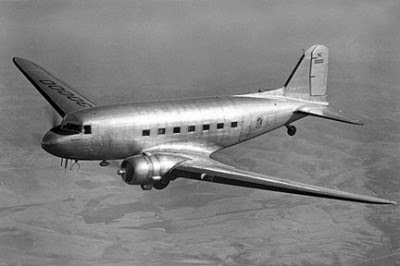
Music is a journey, taking listeners on an emotional and sometimes adventurous sonic path through time to new places both physical and spiritual. Some composers have chosen actual methods of transportation as their theme for this excursion. This October, the Daily Classical Music Post will feature music celebrating methods of transportation, from the land to the sea to the air.
George Antheil: Second Sonata (1922)
Air travel in the 1920s was not a particularly comfortable experience. It was very expensive, so it was reserved for the wealthy and some business travelers. The planes were loud and unpressurized, and as they could only fly at low altitudes during the day, they were a nuisance to people on the ground, who often stopped what they were doing to look up and stare at these unusual machines. Travel times were very slow, often slower than trains, so the main attraction of travelling by air was its novelty. It wasn’t until the end of the 1920s that passenger planes were built and air travel began to really ‘take off’.
The American avant-garde composer George Antheil (1900–1959) explored the sights and sounds of early-20th-century life through his music. His Second Sonata for piano, called the Airplane Sonata, was composed in 1921, and it was the first of his works based on technology. He said in an interview, “I wrote as if by automatic writing a whole but very difficult piano sonata, the Airplane Sonata. I called it that because, as a symbol, the airplane seemed most indicative of that future into which I wanted to escape.”
Maureen Buja wrote, “Antheil’s second piano sonata has the title Airplane Sonata and opens with the tempo designation of ‘To be played as fast as possible’ before launching off into ‘unyielding pounding ostinato fragments’. . . . [T]he work does start with a rather nice uplift to the skies. Once in the air, the music comes to its slow movement. It’s calmer but still dissonant as our plane and pilot find their place in the sky. A swinging melody over a static bass sweeps us away for a while until we get lost in the clouds in a very impressionistic final section.”
Seth Redfield wrote, “The music is not music of an airplane, but music in the spirit of the airplane, of efficient, utilitarian, limitless, and beautiful quality. . . . We tend not to look up at the sound of an airplane anymore, but if we walk past a piano playing this music, perhaps our attention would be held with the same intensity that it held the spectators of the first airplanes.”
My classical music post for today is George Antheil: Airplane Sonata.


Leave a Reply