

Music is a journey, taking listeners on an emotional and sometimes adventurous sonic path through time to new places both physical and spiritual. Some composers have chosen actual methods of transportation as their theme for this excursion. This October, the Daily Classical Music Post will feature music celebrating methods of transportation, from the land to the sea to the air.
The Great Crush Collision March
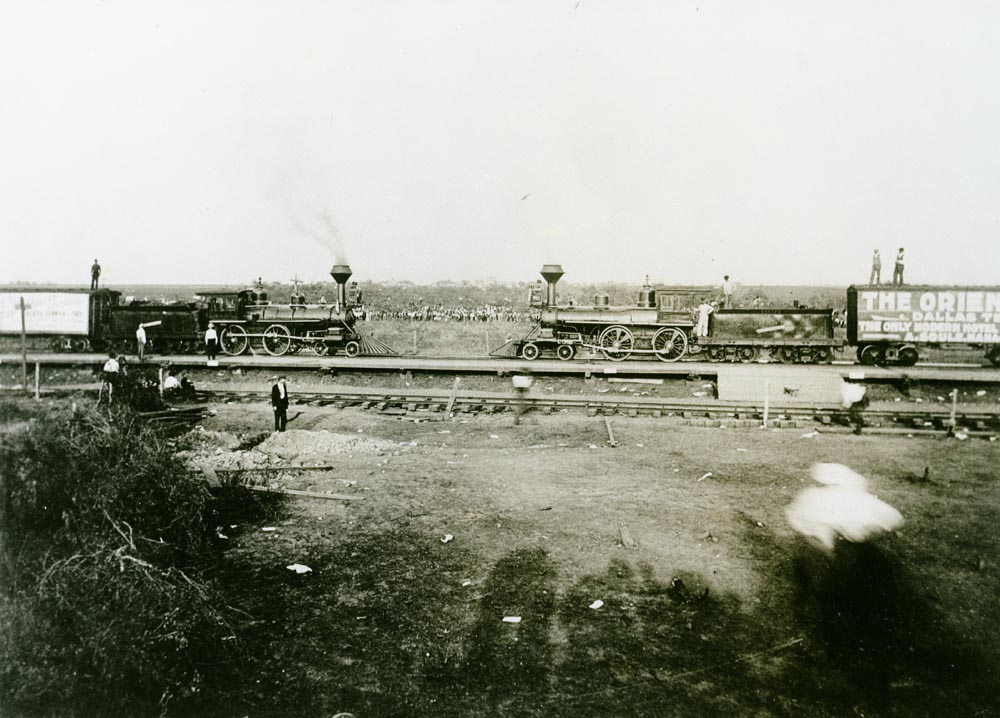
On 15 September 1896, the publicity stunt organized by the Missouri–Kansas–Texas Railroad went horribly wrong. William George Crush, who was the general passenger agent of the Missouri–Kansas–Texas Railroad, thought that this would be a great way to advertise the new locomotives while at the same time getting rid of the obsolete ones. The area where this was to take place was called Crush, named for the bright spark who came up with this idea. All went well until the moment of impact; both engine boilers exploded, hurling metal and other debris into the unsuspecting crowd of more than 40,000 people. Two people were killed and countless others injured. Crush was fired immediately but then rehired without much fanfare, as the railroad line actually benefitted from the publicity after the event.
The American composer Scott Joplin (1868–1917), known as the “King of Ragtime,” always considered ragtime to be a form of classical music. He felt that it should be performed in concert halls. In addition to his ragtime music, he composed two operas. His first opera, A Guest of Honor, was composed in 1901 to commemorate the dinner that President Theodore Roosevelt held at the White House to honour Booker T. Washington. It was most likely never published and is considered to be lost.
Eric Ames wrote, “Scott Joplin was touring Texas in the late 1890s where he saw three of his compositions published in Temple. There was one waltz (Harmony Club Waltz) and two marches, the Combination March and the Great Crush Collision March. The latter of the two marches was dedicated to the “M.K.&T. Ry.,” which is of course the very railroad that had just staged the Crash at Crush. In fact, the work was copyrighted a mere 30 days after the spectacle, leading biographers to believe that Joplin had either witnessed the crash himself or heard about it from one of his acquaintances who worked as a porter on the Katy line. While the particulars of how Joplin learned of the crash are unclear, what is known is his reaction as recorded in song. Joplin created something more than a standard march: he added instructions for creating ‘sound effects’ for the last third of the piece that would depict the crash through music.”
Joplin wrote the following under the score: “The noise of the trains while running at the rate of sixty miles per hour . . . Whistling for the crossing . . . Noise of the trains . . . Whistle before the collision . . . The collision.” The whistles are depicted with appoggiaturas and the collision is a sustained dissonant chord. The Great Crush Collision March is a great example of Joplin’s early compositional style. This piece is also one of the earliest to imitate train noises on the piano.
My classical music post for today is Scott Joplin: The Great Crush Collision March.


Leave a Reply