

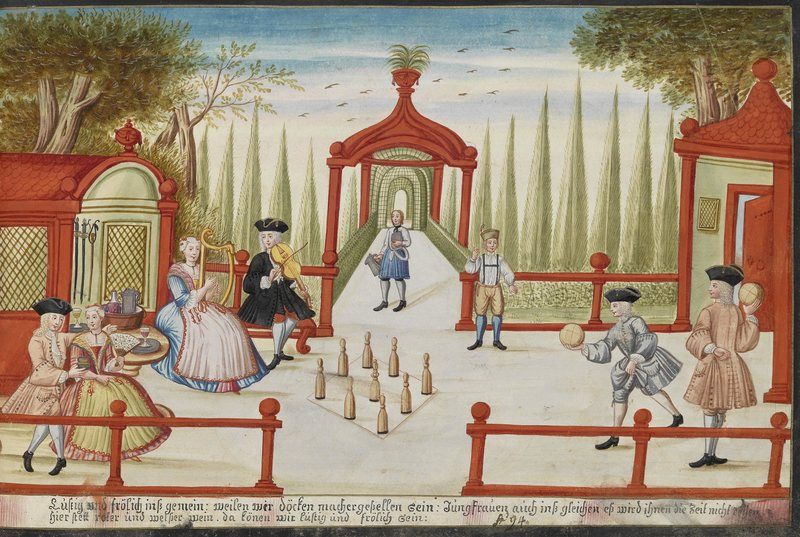
The myth that athletes are the “cool kids” and classical musicians are not is constantly repeated in popular culture, as if these two groups are in opposition. However, many classical composers not only loved to watch and play sports, they also immortalized that love in their music. This September, the Daily Classical Music Post explores classical music about sports.
Trio in E-Flat Major, K. 498 “Kegelstatt”: III. Rondo. Allegretto
Skittles, a game in which players attempt to knock down nine wooden pins arranged in a diamond shape, is the sport from which modern ten-pin bowling developed. Skittles can be played indoors or outdoors, and there are also miniature table-top versions that are played in pubs and bars. Skittles is still a popular game, particularly in Europe. In Germany, kegel is played in organized leagues. The German word Kegelstatt means “skittle alley.”
The prolific Classical composer Wolfgang Amadeus Mozart (1756–1791) did not give his piano trio for clarinet, viola, and piano in E-flat major, K. 498 (1786) the nickname “Kegelstatt”; that was provided by his 19th-century cataloguer Ludwig von Köchel, perhaps inspired by the note that Mozart wrote on the manuscript for his 12 Duos for Two Horns, K. 487, composed not long before K. 498, which read “while playing skittles” (untern Kegelscheiben). Mozart was known to enjoy playing skittles; he once wrote in a letter to his father, “In the meantime, have the skittle-alley in the garden ready.” Mozart composed K. 498 for Franziska von Jacquin, one of his best piano pupils.
Michael Cookson wrote, “This intimate and perfectly blended work was also written in 1786 with Mozart playing the viola at the first performance. It was the first of Mozart’s three great clarinet compositions. The instrumentation in the ‘Kegelstatt’ Trio is creative and enables the use of new textural combinations.” Hank Zauderer wrote, “The scoring of the trio is significant for numerous reasons. Mozart was in the midst of writing his finest chamber music that included a significant compass of the instrumental palette featuring horn, flute, oboe and the string family.”
Jane Vial Jaffe wrote, “The finale with its sunny, lyrical refrain unfolds as a seven-section rondo—A-B-A-C-A-D-A, in which Mozart ingeniously varies each return of the main theme. The mood darkens suddenly for the middle episode with the viola’s stormy outburst in the minor mode. This movement features some especially brilliant passages for all the instruments—the piano in particular, which would have shown off Franziska von Jacquin’s fleet fingers to great advantage.”
My classical music post for today is Wolfgang Amadeus Mozart’s Kegelstatt Trio, K. 498.


Leave a Reply