

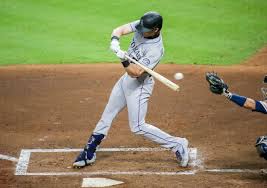
The myth that athletes are the “cool kids” and classical musicians are not is constantly repeated in popular culture, as if these two groups are in opposition. However, many classical composers not only loved to watch and play sports, they also immortalized that love in their music. This September, the Daily Classical Music Post explores classical music about sports.
The Mighty Casey: Scene 2: Oh, somewhere (Watchman)
“Oh, somewhere in this favored land the sun is shining bright; / the band is playing somewhere, and somewhere hearts are light, / and somewhere men are laughing, and somewhere children shout; / but there is no joy in Mudville—mighty Casey has struck out.” (Ernest Thayer, Casey at the Bat, 1888)
The American poet Ernest Thayer wrote Casey at the Bat, known as “the single most famous baseball poem ever written,” to celebrate his love for the game. His comic ballad was meant to strike (no pun intended) a chord with anyone who knew baseball when they read the poem. The poem was first published in The Daily Examiner and then became a staple in vaudeville and theatre performances. There have been many musical adaptations, book-length versions, films, and comics based on the poem.
The American composer William Schuman (1910–1992) based his opera The Mighty Casey (1953) on Casey at the Bat. Schuman, like Thayer, was a big fan of baseball, and he unsurprisingly chose the game as the subject for his first opera. Schuman worked with an advertising executive, Jeremy Gury, to develop the libretto. The music is typical Schuman; Harry Haskell wrote that the score contains “athletic rhythms, leaping vocal lines, major-minor chords and use of ostinatos and semitonal clashes to produce tension.” There aren’t any major singing roles and Casey is played by a mime. As Joseph Polisi wrote, The Mighty Casey is “one of America’s great morality plays presented on a tableau that is purely American and rich with mythological images—the baseball diamond.”
Jeffrey Sandell Stern wrote, “Despite its approachable subject and relative brevity . . . The Mighty Casey was relatively poorly reviewed. . . . William Schuman was determined for The Mighty Casey to succeed and find its place in the canon of American music, as illustrated by his reworking the piece time and time again in a manner unlike any other of his compositions. Along with the modification of the work from opera to cantata [in 1976], Schuman also promoted a four-hand piano arrangement to the Casey choruses in 1959, and he participated in the creation of an abridged version of the work for Education Audio Visual’s ‘Music Appreciation Series in 1980.” Schuman said, “I love that work [Casey] more than anybody else does. . . . I still believe that one day that work is going to find its mark.”
My classical music post for today is William Schuman’s The Mighty Casey: Scene 2: Oh, somewhere.


Leave a Reply