

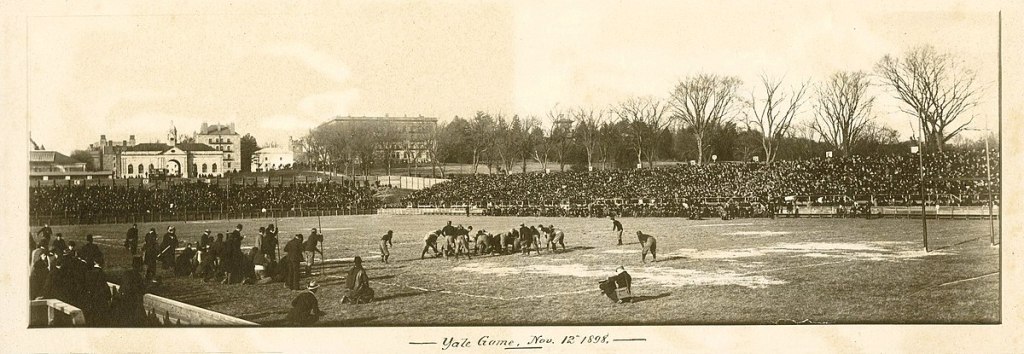
The myth that athletes are the “cool kids” and classical musicians are not is constantly repeated in popular culture, as if these two groups are in opposition. However, many classical composers not only loved to watch and play sports, they also immortalized that love in their music. This September, the Daily Classical Music Post explores classical music about sports.
One of the oldest continuous sports rivalries in the United States of America is the Princeton–Yale football rivalry. These two universities have been competing against each other since 1873. As of this writing, Yale leads the series 81–55–10.
The American modernist composer Charles Ives (1874–1954) loved sports, and by all accounts was good at pretty much every sport he played. He was pitcher and captain of the baseball team at his high school. He was a student at Yale from 1894 to 1898, and he played on the varsity football team during his time there. He also was a top sprinter.
Ives immortalized the Princeton–Yale football rivalry as well as his love for the game in his piece for orchestra, Yale-Princeton Football Game (1898). J.M.K. wrote in programme notes, “On November 20, 1897, [the Princeton Tigers] fell in a bitter 6-0 defeat to the Yale Bulldogs. . . . Ives’ musical portrait of the event (compressed into two downs spread over three minutes) presents the pre-game and post-game clamor, the referee’s whistle, the crowd’s singing and cheering, and the most spectacular highlights of the action itself.”
Ives provided a running commentary in the score: 1. Suppressed excitement of players coming onto grounds; 2. A Yale cheer, “Brekke coax”; 3. Another cheer: “Rah, Rah, Rah; Rah, Rah, Rah; Rah, Rah, Rah; Yale, Yale, Yale.”; 4. “Three Cheers for Old Nassau”; 5. “Harvard has blue stocking girls, Yale has blue stocking men,” etc.; 6. “Watch on the Rhein” (Die Wacht am Rhein); 7. “Hold the fort, McClung is coming.”; 8. “Reeves 2nd Regiment Quickstep” (always played by Brass Band at games and reunions etc.); 9. “Hey-can nuck-a-no”; 10. “Dodging half-back”; 11. “Fat Guards, pushing, grunting.”; 12. “First Down.”; 13. “Run around left end: loss.”; 14. “Dodging tackle.”; 15. “Close formation: Wedge”; 16. “Last Down”; 17. “Run Around Right”; 18. “When trumpet (=Running half-back, Charley Desseaulles, reaches this measure, every other instrument must make a hell of a noise and stop”; “Touch Down.”); 19. “Game over and won. Everybody tired, players and spectators.”
Yale-Princeton Football Game is a typically dissonant and jumbled Ivesian work, with snippets of familiar tunes appearing and disappearing. Ives explains it best: “In picturing the excitement, sounds and songs across the field and grandstand, you could not do it with a nice fugue in C.”
My classical music post for today is Charles Ives’ Yale-Princeton Football Game.


Leave a Reply