

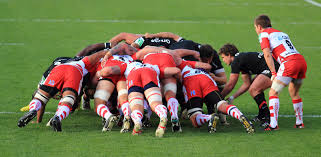
The myth that athletes are the “cool kids” and classical musicians are not is constantly repeated in popular culture, as if these two groups are in opposition. However, many classical composers not only loved to watch and play sports, they also immortalized that love in their music. This September, the Daily Classical Music Post explores classical music about sports.
Although the rules for the game of rugby as we know it (whether its rugby union or rugby league) weren’t codified until 1845, a game similar to rugby can be dated back to some time in the Middle Ages. Rugby split into the two codes, union and league, in 1895, when rugby league became the first to pay players as professionals. Canadian and American football have their roots in rugby. Georg Predota wrote, “The game was introduced into France in the early 1870s, and was played at the Paris Summer Olympics in 1900. It once again featured in the 1920 Olympic Games, and has had a large and dedicated following ever since.”
The Swiss-French composer Arthur Honegger (1892–1955) was a big fan of rugby. In 1928, he composed an orchestral tone poem, Rugby, that received its premiere in Paris. He wrote, “I very much like the game of football, but I prefer rugby. I find it more spontaneous, more direct and closer to nature than football, which is a more scientific game. I am aware of a carefully controlled rhythm in football and for me the savage, brusque, untied and desperate rhythm of rugby is more attractive. It would be wrong to consider my piece as program music. All it does is try and express in my own musician’s language, the attacks and ripostes of the game, and the rhythm and color of a match at the Colombes Stadium; I honestly feel it is only right to name my sources. That is the reason why this short composition bears the title of Rugby.”
Kaden Henderson wrote, “Despite what Honegger may have said, it takes little imagination to find oneself in the middle of the pitch dodging tackles left and right from the very first note. Immediately from the downbeat it is apparent that Honegger is not alluding to two-hand-touch rugby, but rather the sport in its full contact, ‘hold no prisoners’ variety. The very first notes from the strings hit the audience like a ton of bricks as the cascading strings sweep us into a musical dogpile. Violent rhythms and loud brass proclamations provide an energetic backdrop for the strings to demonstrate their virtuosic feats of agility and precision. Honegger really shines in the way he is able to craft dissonant and often grotesque chords into something that is nothing short of brilliant and endlessly entertaining.”
My classical music post for today is Arthur Honegger’s Rugby.


Leave a Reply