

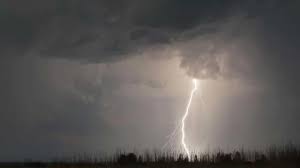
“Everybody talks about the weather, but nobody does anything about it.”—Charles Dudley Warner
Classical music composers may not do anything about the weather, but they often have been inspired by weather and other natural phenomena. This August, the Daily Classical Music Post will explore some of these works and learn about the ways that different combinations of instruments can depict storms, volcanic eruptions, and climate change.
I am writing today’s post on a sunny morning after a night filled with thunder, lightning, and driving rain. The thunder lasted for over two hours, starting off faintly in the distance, settling seemingly over my house for at least an hour, and then moving off into the distance again. There really is nothing quite like a house-shaking thunderstorm.
The American composer John Luther Adams (born 1953) describes his compositions as “profoundly influenced by the natural world and a strong sense of place. Through sustained listening to the subtle resonances of the northern soundscape, I hope to explore the territory of sonic geography—that region between place and culture . . . between environment and imagination.” His compositional style shows influences of Edgard Varèse, John Cage, and Karlheinz Stockhausen. His primary instrument is percussion, and he was timpanist and principal percussionist of the Fairbanks Symphony Orchestra for most of the 1980s.
In 1993, Adams composed his operetta Earth and the Great Weather (A Sonic Geography of the Arctic). The libretto, which Adams wrote, is in English, Iñupiaq, Gwich’in, and Latin (James Nageak and Doreen Simmonds helped with the Iñupiaq translations and Adeline Peter Raboff and Lincoln Tritt helped with the Gwich’in translations). Earth and the Great Weather was commissioned by the Festival of Native Arts at the University of Alaska at Fairbanks.
Adams wrote in the programme notes, “Earth and the Great Weather is a journey through the physical, cultural, and spiritual landscapes of the Arctic, in music, language, and sound. . . . Three drum quartets are interspersed throughout the work and are inspired by the elemental power of natural forces in the Arctic and by the ecstatic energy of Alaska Native drumming and dancing.” Howard Klein wrote, “The extended drum pieces in Earth and the Great Weather are, in a sense, Adams’ homage to that earlier period in American percussion music and a return to his own roots as a drummer. . . . Adams says: ‘This is the first time I’ve let go and enjoyed the sheer physical power and exhilaration of drumming on this scale.’ The pieces contain no improvisation, but are rigorously scored, using extensive metric modulations and ‘layers of different rhythmic velocities, which amount to several superimposed tempos’.”
My classical music post for today is John Luther Adams’ Earth and the Great Weather: Deep and Distant Thunder.


Leave a Reply