

“Everybody talks about the weather, but nobody does anything about it.”—Charles Dudley Warner
Classical music composers may not do anything about the weather, but they often have been inspired by weather and other natural phenomena. This August, the Daily Classical Music Post will explore some of these works and learn about the ways that different combinations of instruments can depict storms, volcanic eruptions, and climate change.
The British composer Barry Guy (born 1947) is one of those rare musicians who really is at home in classical as well as jazz music. He was principal double bass in several orchestras, and at the same time he was known for his jazz improvisation and compositions. He was one of my favourite composers to talk to when I worked at Novello’s in London, as I learned a lot from him—and we shared a love for music of the Renaissance! One of my favourite Guy pieces is After the Rain, for string orchestra, composed in 1992. This work is quite closely related to some of the pieces that he composed for the London Jazz Composers Orchestra.
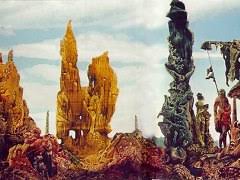
In the programme notes to After the Rain, Guy wrote, “In effect, After the Rain is a slow movement punctuated by an active refrain that elongates as the piece progresses. The final form was decided following a visit to the Tate Gallery in London to view the 1991 exhibition of Max Ernst: a retrospective. Here I had the good fortune to see close up his painting Europe After the Rain. The canvas portrays four large masses of tortuous baroque-like remains as if left after some unfathomable catastrophe which are somehow held in a non-violent state of animation. . . . Here in Europe After the Rain could be the apotheosis of anxiety and destruction or the emergence of new life from the ruins. I am drawn to the latter. I am also drawn to polyphony as practised in Renaissance music. Ernst’s painting resonated with sonorous voices from this distant age, so it seemed appropriate therefore to respond by aligning the various sections with known forms of the period.”
A reviewer in Gramophone wrote, “After the Rain’s brightest [movement] is an ecstatic, high-reaching Canon (section six). . . . [It] is a veritable power-house of string sonority. After the Rain wears its heart on its sleeve which, given the urgency of its images and the freshness of its inspiration, is precisely where it should be.”
My classical music post for today is Barry Guy’s After the Rain: VI. Canon.


Leave a Reply