

Thank you to everyone who subscribes to and supports the Daily Classical Music Post. This July, I will be sharing some favourite posts from the DCMP archives. A new theme will begin in August!
10 December 2017
“If more of us valued food and cheer and song above hoarded gold, it would be a merrier world.”—JRR Tolkien
This December, join the Daily Classical Music Post for a grand meal! We will work our way through the preparation of the meal and the arrival of the guests to the farewell after a wonderful evening!
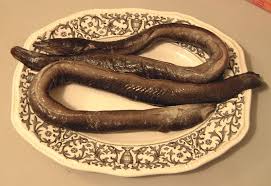
Pieces de clavecin, Book 4: 22nd Ordre in D Major-minor: L’Anguille (The Eel)
What did you say these little things are? Eel? Yes, I would love to try one!
François Couperin (1668–1733), like many French composers of the day, composed “character” pieces for the keyboard. A piece named for a bird might have lots of little trills, “buzzing sounds” would be commonplace in a work about a fly or other insect, and, in today’s wonderful little work by Couperin, L’Anguille, the listener can hear the writhing of the eel.
Alan Cuckston says, “Couperin published his fourth and last book of harpsichord pieces in 1730, disclosing in its preface that, owing to the decline in his health, he had been unable to compose any new music during the previous five years. The 22nd Suite is in the bright and optimistic key of D, and its opening pieces celebrate a Victory with its Trophy (La Trophee), and a pair of Airs (both Minuets) in contrasting major/minor tonalities. It is possible that it is the fountain in the park at Versailles called ‘Le point du jour’ rather than Daybreak itself which is depicted in the following Allemande. A slippery Eel (L’Anguille) appears next, its physical motion graphically conveyed in wriggling chromatics.”
My classical music post for today is François Couperin’s L’Anguille.


Leave a Reply