

Ask people what genre they think film music is—is it classical? You will get widely varying responses. For some people, film music is a subgenre of classical music; for others, it is a completely separate genre that stands on its own. This June, the Daily Classical Music Post will look at the origins of film music and discover how it has evolved.
Sometimes a chance meeting will lead to a wonderful collaboration between a film director and a musician who could create the perfect score for their films. When the director and the composer have a shared vision, their creative partnership can lead to extremely successful productions. Some of the most celebrated pairs are Steven Spielberg and John Williams, Christopher Nolan and Hans Zimmer, Tim Burton and Danny Elfman, Sergio Leone and Ennio Morricone, and Darren Aronofsky and Clint Mansell.
The English musician and composer Clint Mansell (born 1963) never had any formal musical training. He was the lead singer for Pop Will Eat Itself, an alt-rock band. In the mid-1990s, after the band broke up, Mansell moved to the United States of America to become a film score composer. As he didn’t have any training, he often employs an orchestrator to help him realise his musical visions, which blend orchestral music, minimalism, motif development, and electronic textures. If he incorporates any rock music styles at all, they are subtle.
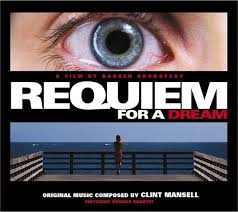
Mansell met the director Darren Aronofsky in 1996 when both were living in New York and just beginning their careers in the film industry. They bonded over their mutual opinions about the state of film music (Mansell said in an interview, “When I first met Darren Aronofsky, one of the first things we agreed about was the fact that we didn’t like film music because it was rubbish and wallpaper and just sits there a lot of the time.”). Aronofsky asked Mansell to write the score to Pi (1997). That score and their collaboration was so successful that Aronofsky asked Mansell to compose the music for his next film, Requiem for a Dream (2000).
Marisa Mirabal wrote, “Director Darren Aronofsky’s ‘Requiem for a Dream’ is one of the most stunning and heartbreaking films to ever depict the loneliness and depravity associated with addiction.” Bettina Makalintal wrote, “The last minutes of Darren Aronofksy’s Requiem for a Dream are a sweaty, shivering fever of an anti-drug PSA that finds the film’s four main characters each curled in the fetal position, reeling from the effects of addiction. Those tension-spiked moments are set to the sounds of a string quartet that build from a lilting chord progression to a mournful and fervent crescendo.” Mansell described how he came up with the music for “Lux Aeterna,” which is the title of this cue: “Darren had said, ‘It’s like a horror movie, really. Every time that the addiction wins, that’s a win for the monster’. ‘Lux Aeterna’ is basically a monster theme.”
“Lux Aeterna” has become a favoured piece of music to use in trailers for other films, advertising, on television series to underpin dramatic moments, and video game trailers, and his film music has been performed live in concert worldwide. One of the most well-known uses of “Lux Aeterna” was the epic large-scale adaptation that was made for the trailer for Lord of the Rings: The Two Towers. You can see that trailer here: The LOTR – The Two Towers (Official Trailer 2 HD Blu Ray). As Mansell said in an interview, “[‘Lux Aeterna’ has] just gone on to have a life of its own.”
My classical music post for today is Clint Mansell’s Requiem for a Dream: “Lux Aeterna.”


Leave a Reply