

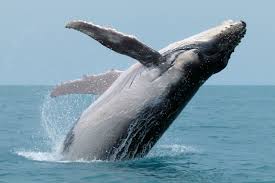
A is for April, and it’s also for Animals! This April, the Daily Classical Music Post explores music celebrating the animal kingdom.
And God Created Great Whales, Op. 229, No. 1
“His signing hands showed me the whale in an ocean that suddenly went quiet, swimming over there, over there, trying to find the sounds again.”—Lynne Kelly
The American composer Alan Hovhaness (1911–2000) composed well over 500 works, which made him one of the most prolific composers of the 20th century. He began composing at the age of 4, and as a teenager came to the attention of the American composer Roger Sessions. Later in his life, Hovhaness destroyed many of his early works, mainly because Sessions had criticized them. Hovhaness’ music explores his interest in his Armenian heritage, his fascination with astronomy and nature, and mysticism. He composed in what he described as a melodic pentatonic and asynchronous aleatoric style, saying that his music sometimes was “free non-rhythm chaos.” He said, “I am more interested in creating fresh, spontaneous, singing melodic lines than in the factory-made tonal patterns of industrial civilization or the splotches and spots of sounds hurled at random on a canvas of imaginary silence.”
Hovhaness composed his symphonic poem And God Created Great Whales, Op. 229, No. 1, in 1970 to a commission by Andre Kostelanetz and the New York Philharmonic. The work, scored for orchestra and recorded whale sounds, was well received and remains one of Hovhaness’ most popular pieces. Along with the cantata The Whale by John Cage, And God Created Great Whales has been credited as an early work in the movement to save whales from extinction. Rob Barnett said, “[And God Created Great Whales] mixes the taped sounds of the ‘song’ of various species of whale . . . with a mystical score calling up the wash and depth of an imagined Eastern sea. There are some parallels here with the taped birdsong in Einojuhani Rautavaara’s Cantus Arcticus. This is a powerful amalgam and made extremely moving in the counterpoint between the whale song and Hovhaness’s inspired music.”
The programme notes said, “This composition incorporates segments of actual whale songs. The first segment contains the edited song of one whale, recorded off St. David, Bermuda, by Frank Watlington (Columbia University Geophysical Field Station in Bermuda). The second segment contains material recorded by Dr. Roger S. Payne near Bermuda in the spring of 1969. Segment three consists of certain notes recorded by Mr. Watlington which have been artificially slowed down to one-fourth normal speed; thus the pitch is lowered four octaves. The final segment contains some of the lowest sounds produced by humpbacks.”
An anonymous reviewer on the Good Music Guide website said, “And God Created Great Whales . . . depicts the transformation of chaos to beauty, the creation of the earth, the oceans and whales. He uses a typical Hovhaness technique that he calls Senza Misura where the original chaos is represented by the string players performing musical fragments independent of each other, which gradually coalesce into form. But the true stars of this work are the whales, whose songs are an integral part of the work, majestic, dignified and sad.”
My classical music post for today is Alan Hovhaness’ And God Created Great Whales.


Leave a Reply