

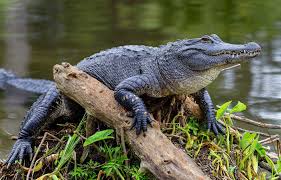
A is for April, and it’s also for Animals! This April, the Daily Classical Music Post explores music celebrating the animal kingdom.
“Far off in the red mangroves an alligator has heaved himself onto a hummock of grass and lies there, studying his poems.”—Mary Oliver
The American composer Charles Wuorinen (1938–2020) was basically a serialist, but he never liked that term. His works are technically advanced and require a great deal of expertise from the performers. Mathematical theory plays a large part in many of his compositions. He composed just one electronic work, which won him a Pulitzer Prize for Music, but he preferred to work with what he called “natural” instruments.
On Alligators, composed in 1972, was written for a small chamber group of eight players: a wind quartet and a string quartet. This piece has been described as “colourful” and “intense.” Christian Carey said, “[On Alligators] is filled with bold, angular gestures and brash virtuosity.”
Grego Applegate Edwards said, “When I was in the peak of my aspiring composer days, schlepping around Manhattan soaking up what I could of the contemporary music world there, I attended a new music concert of works by the new modernists.. . . What got my attention was Charles Wuorinen’s chamber work ‘On Alligators.’ This was around 1972. What impressed me was its dynamic forward movement. . . . Wuorinen by reputation was probably at that point New York’s most well regarded new composer. He taught at Columbia, he had just won a Pulitzer Prize, he was big. ‘On Alligators’ confirmed for me that his reputation was deserved.”
My classical music post for today is Charles Wuorinen’s On Alligators.


Leave a Reply