

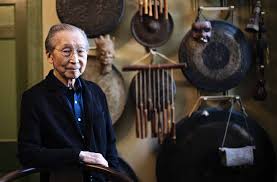
There has always been a cultural exchange between the arbitrarily divided regions labelled East and West. However, the overwhelming influence of European and U.S. art and folk music often obliterated the traditional classical music in Asia. This March, the Daily Classical Music Post explores music by Asian composers who have sought to redress the balance.
[Chou Wen-chung] The Willows Are New (Score-Video)
The Chinese American composer Chou Wen-chung (1923–2019) emigrated to the United States of America in his early 20s. Chou said of his early musical training, “While in Qingdao, I first discovered the meaning of music in life when I heard our household help enjoying their free time by playing instruments, singing, and drinking. . . . [I]t was in Wuhan that I discovered the violin when my older brothers and I bought a child-size violin as a toy. My oldest brother, Wen-tsing, immediately began taking lessons and recruited me as his ‘student’! I played the erhu, studied the violin and taught myself a medley of instruments, such as mandolin, harmonica and musical saw.”
Chou was offered a scholarship to study architecture at Yale, but he really wanted to study music. He gave up the scholarship and studied composition with Nicholas Slonimsky, Edgard Varèse, and Otto Luening. Chou wanted to incorporate Chinese musical elements with Western techniques and styles. Peter Chang said, “On one occasion, Chou showed his Chinese-flavored fugues to Bohuslav Martinů, who started to read them on the piano and suddenly stopped after a few measures. He looked at Chou and simply uttered one word: ‘Why?’ Chou could not answer. Such an embarrassment disturbed him profoundly and made him realize that substituting pentatonic for heptatonic modes in fugue, which had been developed in the heptatonic and triadic tradition, was like putting Chinese words into Bach’s mouth. Fugue was Bach’s natural language, but not his. Chou believed that this was one of the greatest lessons he ever had because, beginning with the word ‘why,’ he had to satisfy his own questions before moving on.”
Nicholas Slominsky said, “Chou Wen-chung is possibly the first Chinese composer who has attempted to translate authentic oriental melo-rhythms into the terms of modern Western music. . . . He addressed the problem of conciliation between melodic pentatonicism and dissonance.” This synthesis of two styles is apparent in his work for solo piano, The Willows Are New (subtitled “After Wang Wei’s ‘Yang Kuan’”), composed in 1957. Notes in the score say, “Yang Kuan, another ch’in work bearing the name of the poem by Wang Wei (689–759) that inspires it, has been refashioned into a composition in which ‘mutations of the original material are woven over the entire range of the piano and embroidered with sonorities that are the magnified reflexes of brushstroke-like movements.’ The title, The Willows Are New, comes from a line in that poem which the composer has translated.” A review of The Willows Are New said, “In The Willows are New, clusters and unorthodox harmonies alter our response to the piano’s usual romantic inclinations, and unconventional rhythmic gestures are meant to suggest the contemplative yet spontaneous brush strokes of the Asian calligraphic arts.”
My classical music post for today is Chou Wen-chung’s The Willows Are New.


Leave a Reply