

There has always been a cultural exchange between the arbitrarily divided regions labelled East and West. However, the overwhelming influence of European and U.S. art and folk music often obliterated the traditional classical music in Asia. This March, the Daily Classical Music Post explores music by Asian composers who have sought to redress the balance.
Slamet Abdul Sjukur – “Jawara” for percussion solo
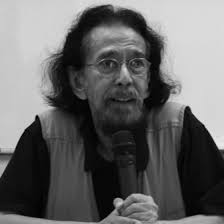
The Indonesian composer Slamet Abdul Sjukur (1935–2015) studied composition with Olivier Messiaen and Henri Dutilleux. He later taught in Jakarta but was considered to be too unconventional and so gave up and concentrated on composing. He won many awards in Europe. In the late 1990s and early 2000s, he was recognized in Indonesia for his contributions and was made a life member of the Akademi Jakarta. Ken Jenie said, “Through his body of work and accomplishment, Slamet Abdul Sjukur was dubbed to be the father of Indonesian Contemporary Music. Still, this is a name that only a few Indonesians know, and even the nickname doesn’t even begin to describe his contribution to Indonesian music.”
Through his minimal use of sounds along with numerological concepts, Sjukur (better known in Indonesia as SAS) developed what he called “minimax” in music composition. Iwan Gunawan said, “Minimax is the thought of composer Slamet Abdul Sjukur as another option that departs from (minimal) limitations and utilizes them to the maximum. This concept is considered very conducive to developing creativity and sensitivity, especially in the context of music education. Based on musical composition observations, various aspects are similar between Slamet Abdul Sjukur’s Minimax concept and several ethnic music concepts in Indonesia, especially regarding the idea of limiting the musical material.”
Sjukur’s output includes stage works (operas, ballets, incidental music), orchestral works, chamber music, choral works, and solo instrumental works. Many of his works reflect his interest in indigenous Indonesian music as well as forms such as kronchong (folk music that was influenced by Portuguese colonists in Indonesia). His compositions reflect what he said in an interview: “To me, music is not the matter of just human creativity, it’s how we perceive the sound of the universe, so that the sound of the universe has a deeper meaning than just a sound. To me, that’s what music is. Many people consider thunder and heavy rain as something that just passes by. For me, that kind of moment also is a music because of its pressure and accent. That’s music for people who really cares about music. No matter how people play a musical instrument, if it doesn’t connect with the listeners, then for me it’s not music at all.”
Jawara was composed in 1993 for solo percussion. This very quiet and peaceful piece contains all of Sjukur’s elements of composition: indigenous music, silence, interesting counterpoint and melodic sections, all within a modern and contemporary classical music format. You might have to turn up the sound as you listen, as some of the sections are very quiet indeed!
My classical music post for today is Slamet Abdul Sjukur’s Jawara.


Leave a Reply