

There has always been a cultural exchange between the arbitrarily divided regions labelled East and West. However, the overwhelming influence of European and U.S. art and folk music often obliterated the traditional classical music in Asia. This March, the Daily Classical Music Post explores music by Asian composers who have sought to redress the balance.
Hwang-Long Pan Harmony of the World for Orchestra (1987)
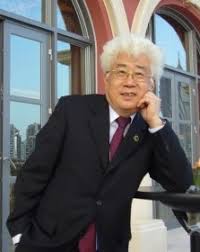
The Taiwanese composer Hwang-Long Pan (born 1945) first studied in Taiwan and later in Zurich, Hanover, and Berlin. He then returned to Taiwan, where he taught composition and was active in the contemporary classical music scene. He has composed for orchestra, solo instruments including piano, and voice. He has won many awards for his works. Many of Pan’s compositions are influenced by Chinese philosophical or mythical concepts.
Bernard Holland wrote in 1994 in a review of Pan’s music, “Composers of Taiwan like to make 1945 a year of beginning. Before, they had looked to themselves or to neighbors for inspiration. After 1945, Europe and the rest of the world lay open. This coming-out has not been easy. . . . The struggle is familiar: identity versus assimilation. How is one to be a Chinese musician in an international community of music?” Holland also wrote in another review, “Mr. Pan’s metaphors for Asian instruments are acute: delicate bowing and shuddering tremolos, Western portamento that becomes an agent for the East’s more slippery sense of pitch. . . . The fragile indeterminacies flow easily into pentatonic melody, but they are arranged according to Western principles of imitating voices and developing ideas.”
Pan’s Harmony of the World was composed for orchestra in 1987. Wan Chuang-Wang said, “[Harmony of the World] represents the ideal harmony world in Confucianism. Although Pan Hwang-Long’s music is well-known for being avant-garde, he often shows the mind of Eastern philosophy. He uses the creative skills which he had learned during the period of studying in Europe and combines the spirit and imagery of the East. . . . He attempts to express not only the ritual, humble and peaceful essence in Confucianism, but also the harmony scene in modern society. Furthermore, he represents the extraordinary magnanimity of the concept of ‘Great Music Is Simple’ in Eastern music by linking acoustical skills and artistic concepts together.”
My classical music post for today is Hwang-Long Pan’s Harmony of the World.


Leave a Reply