

There has always been a cultural exchange between the arbitrarily divided regions labelled East and West. However, the overwhelming influence of European and U.S. art and folk music often obliterated the traditional classical music in Asia. This March, the Daily Classical Music Post explores music by Asian composers who have sought to redress the balance.
CU Chamber Ensemble – บัวขาว (Bua Khao by Thanpuying Puangroi Apaiwong)
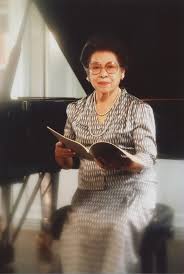
The Thai composer Thanpuying Puangroi Apaiwong (1914–2000) is considered to have been the first woman composer in Thailand. She was particularly known for the way that she combined Western musical notation and traditional Thai instruments. She was one of the most prominent composers who wrote in the Phleng Thai sakon genre, as this fusion of Western and Thai musical elements was called (it translates roughly as “international-style Thai music”).
Apaiwong learned piano and guitar as a child and later went to Trinity College London to study music formally. She then returned to Thailand to perform and also to teach music. Her most famous work was the song “Bua Kao” (White Lotus), composed in 1937 for a film score. It is considered to be a classic in Thailand. In 1979, UNESCO named it as a “Song of Asia.” Her output includes more than 100 compositions. She composed works for plays and films as well as many pieces for the Thai royal family.
Apaiwong was celebrated by Google Doodles on the 105th anniversary of her birth. The accompanying description said, “Apaiwong devoted her life to music, playing weekly for nearly 22 years with a group of classical musicians to raise funds for various educational institutions. She was also awarded the Performing Arts award by the Board of National Culture in 1986, as well as five royal decorations for her contributions.”
My classical music post for today is Thanpuying Puangroi Apaiwong’s “Bua Kao.”


Leave a Reply