

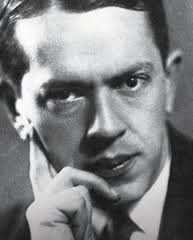
William Cosgrove famously said, “Music hath charms to soothe a savage breast.” At this pivotal moment in the world’s history, the Daily Classical Music Post explores music by composers who ran afoul of tyrants and dictators and who as a result were banned, imprisoned, or executed. We’ll also listen to some music by composers who criticized the regime under which they worked but managed to fool the ruler.
Mosolov: Iron Foundry (machine music) , Op. 19
The Soviet composer Alexander Mosolov (1900–1973) was successful in his early career, particularly in the 1920s. However, by the late 1920s he was labelled a dangerous counter-revolutionary by the Soviet authorities, perhaps because he had begun including Central Asian folk songs in his compositions, something that went against the socialist realist aesthetic in place at the time. In 1932, he wrote to Joseph Stalin asking him for help: “Since 1926, I am an object of permanent badgering. Now, this has become insufferable. I must compose, and my works must be performed! I must test my works against the masses; if I come to grief, I’ll know where I must go.” He asked Stalin to allow him to travel outside the USSR to compose with more freedom.
Stalin’s response was to have him arrested and sentenced to eight years in the Gulag. A few prominent musicians argued for Mosolov’s release, and this was granted after a year, although the terms of the release were that he could not live in Moscow, Leningrad, or Kiev until the early 1940s. What is notable is that his compositions after his release are very different from those dating from before his imprisonment. Basically, he agreed to toe the [musical] party line. Marina Frolova-Walker said, “It is impossible to discern the former avant-gardist in the works written from the late thirties onward.”
Mosolov incorporated folk music in his compositions long before the Soviet musical establishment mandated it. And although he continued to use folk tunes after he was “rehabilitated,” the dense textures and polytonality of his early compositions is nowhere to be seen nor heard in his later work. His most well-known work, written before things started to go really wrong for him, was Factory: machine-music, more commonly known as the Iron Foundry (1926/27). This prime example of Russian futurist music was originally the first movement of music for the four-movement ballet suite Stal (Steel). The other three movements were lost, so the Iron Foundry is now a standalone orchestral piece.
Giles Masters said, “In the concert hall, one product of the [1920s] machine vogue was a new sub-genre: compositions that used traditional orchestral instruments to depict the noisy technologies of production and transportation characteristic of early twentieth-century industrialism. In music, there is perhaps no better example of this tendency towards expansive, unruly circulation than a short orchestral work by the Soviet composer Aleksandr Vasil’yevich Mosolov . . . known outside Russia as the Iron Foundry. . . . [W]hat makes the Iron Foundry truly remarkable as a transnational historical phenomenon is its life outside the Soviet Union. Although Mosolov is an obscure figure today, his name was once much more widely known. From 1930, his machine-inspired composition . . . became hugely popular across Europe, North America, and beyond. While its fame lasted, few other works of contemporary orchestral music enjoyed such widespread interest and acclaim.”
My classical music post for today is Alexander Mosolov’s Iron Foundry.


Leave a Reply