

Christmas is so commercialized and mostly about consumerism, but at its root it is about birth, peace, joy, love, light, and goodwill. This December, the Daily Classical Music Post will look at music that celebrates birth, rebirth and resurrection, peace, hope, and joy.
Mahler: Symphony No. 2 (with Score)
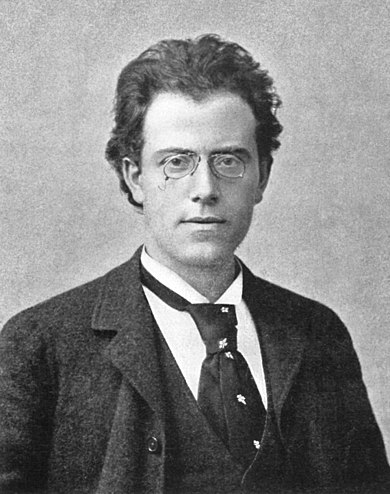
The Austro-Bohemian Romantic composer Gustav Mahler (1860–1911) is quite a polarising composer; either you really love his (it must be said) really long works, or you absolutely refuse to listen. In his lifetime, his works were met with both enthusiasm and distaste. He then was basically neglected after his death, and as he was born Jewish (although he converted to Catholicism), his music was deemed “degenerate” by the Nazis and so was banned. However, in the 1950s, orchestras began to perform his works again, and interestingly, the invention of the LP (long-playing record, for those of you too young to remember) really helped.
Mahler’s Symphony No. 2, known as the Resurrection Symphony, was composed between 1888 and 1894 and was first performed in 1895. Mahler first got the idea for a work reflecting his lifelong beliefs of an afterlife and resurrection following the death of his friend, fellow conductor Hans von Bülow. At Bülow’s funeral, Mahler heard a setting of a poem about resurrection. He said in a letter to a friend that “[i]t struck me like lightning, this thing, and everything was revealed to me clear and plain.” Mahler used the first two verses of the hymn and then added his own text dealing more explicitly with redemption and resurrection.
The Resurrection Symphony was the first of Mahler’s symphonies to pair orchestral writing with voice and language. In the manuscript score, Mahler included directions for a five-minute pause between the end of the first movement and the start of the second—an exceptionally long break at an early stage in a performance, and one that not all conductors observe. Mahler said in a letter to conductor Julius Buths, “[T]here must also be a long, complete rest after the first movement since the second movement is not in the nature of a contrasting section but sounds completely incongruous after the first. This is my fault and it isn’t lack of understanding on the part of the audience. . . . While the first, third, fourth, and fifth movements are related in theme and mood content, the second is independent, and in a sense interrupts the stern, relentless course of events.” In a letter to a music critic, Mahler said, “With the finale of the Second Symphony, I ransacked world literature, including the Bible, to find the liberating word, and finally I was compelled myself to bestow words on my feelings and thoughts.”
John Hencken said, “Mahler conducted the first three movements with the Berlin Philharmonic in March of 1895, and in December that year he led the same orchestra in the premiere of the full work. Even before those performances, however, Mahler had a confident idea about just what the impact of this music would be. ‘The effect is so great that one cannot describe it,’ he wrote to a friend after some preliminary rehearsals in January of 1895. ‘If I were to say what I think of this great work, it would sound too arrogant in a letter. . . . The whole thing sounds as though it came to us from some other world. I think there is no one who can resist it. One is battered to the ground and then raised on angel’s wings to the highest heights’.”
My classical music post for today is Gustav Mahler’s Symphony No. 2, Resurrection.


Leave a Reply