

Christmas is so commercialized and mostly about consumerism, but at its root it is about birth, peace, joy, love, light, and goodwill. This December, the Daily Classical Music Post will look at music that celebrates birth, rebirth and resurrection, peace, hope, and joy.
Nikolai Obukhov: Le livre de la vie – Préface
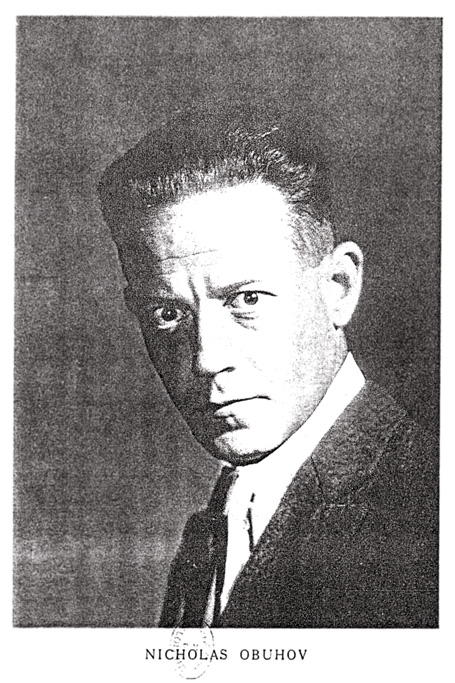
The modernist and mystic Russian composer Nikolai Obukhov (1892–1954) fled Russia after the Bolshevik Revolution and moved to France. His music, which shows the influence of Alexander Scriabin, incorporates religious mysticism, unusual notation, and his own unique 12-tone chromaticism. He was an early proponent of electronic music. When he moved to France, he studied with Maurice Ravel, who helped the impoverished young composer get established (although most of Obukhov’s money came from his work as a bricklayer). He was one of the inventors of the croix sonore, a theremin-like electronic instrument built in the shape of a cross, which later featured in many of his works.
He was attacked and severely beaten in his apartment in 1949 by a gang of men; this injured him to the extent that he ceased composing. The gang also ran off with the score of his monumental work for voices and orchestra, The Book of Life (1926; also called Kniga Zhizni or Le livre de vie). This work was an enormous undertaking, and Obukhov’s wife was so fed up with his obsession with it that she cut up an early version of the manuscript. Obukhov repaired it and left drops of his blood on it. Some of the performance markings in the score were also in his blood.
The score, some of which was in the shape of the cross, was kept on a shrine in their apartment. Obukhov claimed that he wasn’t actually composing the work but, rather, acting as an intermediary. The Prologue was the only section of the massive composition to be performed in his lifetime. Obukhov intended for the entire work to be performed only once a year on the occasion of Christ’s resurrection, in a special cathedral to be built specifically for the purpose. The stolen score contained approximately 800 pages. The copy in the Bibliothèque Nationale de France contains more than 2,000 pages.
Larry Sitsky said, “Obukhov’s ‘Book of Life’ is also a ‘Mystery,’ and, like every self-respecting mystery is ‘revealed’ to him from above. . . . Obukhov’s mystery has a political purpose—the restoration to the throne of the last Russian Emperor, who is supposed to be alive and well, but in hiding.” From the start of the Prologue, this mesmerizing work, with a Russian text, is somewhat overwhelming. It’s understandable that Obukhov intended that there would not be an audience but only spectators who would be involved in the performance, as it is difficult to imagine being present and not wanting to participate.
My classical music post for today is Nikolai Obukhov’s Book of Life: Prologue.


Leave a Reply