

Christmas is so commercialized and mostly about consumerism, but at its root it is about birth, peace, joy, love, light, and goodwill. This December, the Daily Classical Music Post will look at music that celebrates birth, rebirth and resurrection, peace, hope, and joy.
3 Paraphrases gregoriennes, Op. 5: No. 1. Mors et Resurrectio
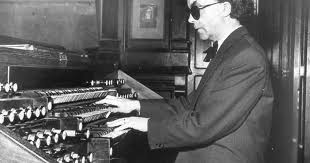
The French composer and organist Jean Langlais (1907–1991) lost his sight at the age of two. He was sent to the Institut National des Jeunes Aveugles, where he learned to play the organ. He then studied with Marcel Dupré and Paul Dukas at the Paris Conservatoire, where he won several prizes in organ. He also studied improvisation with Charles Tournemire. He spent much of his life as the organist of the Basilica of Sainte-Clothilde in Paris (over 40 years), and he also was internationally famous as a concert organist.
Langlais’ music is an interesting combination of old and new, particularly medieval music and 20th-century innovations. Gregorian chant in particular formed the basis for many of his works, including his Trois Paraphrases Grégoriennes.
Langlais composed the Trois Paraphrases Grégoriennes between 1934 and 1935. Stephen Westrop said that this composition is “not only one of his earliest works of real maturity but also one of his most enduringly popular. Mors et Resurrectio is prefaced by words of St Paul to the Corinthians, ‘Death, where is thy victory?’, and proceeds inexorably in three mighty waves. The composer identifies two themes: the first, which is of his own invention, represents death and builds gradually from the depths; the second, based on the Introit from the Mass for the Dead, represents life and is first heard on a trumpet stop. After a double exposure of these two ideas the plainsong theme is treated more extensively and develops into an all-engulfing climax. The music has a sense of grandeur, conjuring up the vast and imposing spaces of a Gothic cathedral.”
Lionel Salter has pointed out that unless you are an organ buff or a church musician, you probably won’t know Langlais’ music. Melvin West noted that during Langlais’ lifetime, he was very much in demand as a performer in the United States of America, as “the organ world here is very receptive to his works.” West said, “[Mors et Resurrectio] recalls an early Schoenberg composition . . . [T]hat is, it is rather Wagnerian in its harmonic and textural concept.” The third section of the piece is the one that depicts the resurrection.
My classical music post for today is Jean Langlais’ Trois Paraphrases Grégoriennes: Mors et Resurrectio.


Leave a Reply