

The first work of a classical composer can provide a glimpse of who that composer will become, or it can seem as if it was written by a totally different musician. This November, the Daily Classical Music Post will explore some first works (or Op. 1 works, not always the very first work) by composers familiar and unfamiliar.
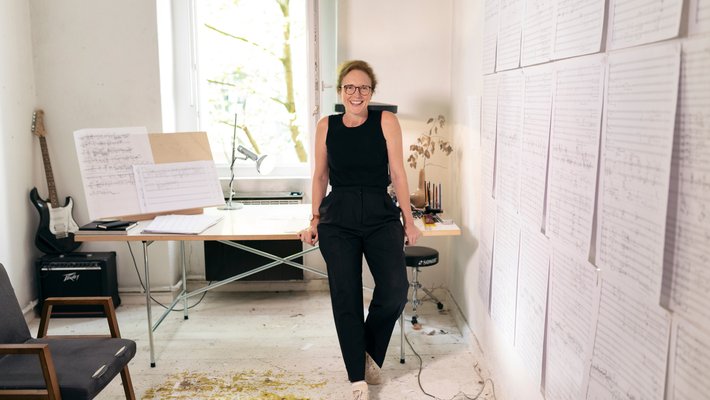
Rebecca Saunders … Behind the Velvet Curtain
The British composer Rebecca Saunders (born 1967) is one of the leading composers of her generation. Her biography on her website says, “Saunders pursues an intense interest in the sculptural and spatial properties of organised sound. . . . Her compositions have been recognised with numerous international prestigious awards, including the 2019 Ernst von Siemens Music Prize, . . . the Paul Hindemith Prize, four Royal Philharmonic Society Awards, . . . four BASCA British Composer Awards, . . . and the GEMA Music Prize for Instrumental Music.”
Saunders’ first published work was Behind the Velvet Curtain, composed for trumpet, piano, harp, and cello in 1991. She said in the programme notes, “When composing I imagine holding the sounds and noises in my hands, feeling their potential between my palms, weighing them. Skeletal textures and musical gestures develop out of this. Then, like pictures placed in a large white room, I set them in silence, next to, above, beneath and against each other. Written with my grateful thanks to the soloists of the Ensemble of the Neuen Komponisten Gesellschaft, Behind the Velvet Curtain was written at the beginning of my studies with Wolfgang Rihm in Karlsruhe in 1991.”
Behind the Velvet Curtain received its premier in 1992 at the Musikhochschule Karlsruhe. Robert Adlington said, “[H]er two earliest published works trace the evolution of a technique that come to be central to every piece thereafter. In Behind the velvet curtain, a succession of single notes is passed between the four instruments . . . to form a prolonged melody. . . . Flaws that are not apparent to the naked eye (or ear) suddenly become perceptible. Behind the velvet curtain thus represents an intermediate stage of a process that, in later works, homes in on the molecular grain and imperfections of single pitches.”
My classical music post for today is Rebecca Saunders’ Behind the Velvet Curtain.


Leave a Reply