

The first work of a classical composer can provide a glimpse of who that composer will become, or it can seem as if it was written by a totally different musician. This November, the Daily Classical Music Post will explore some first works (or Op. 1 works, not always the very first work) by composers familiar and unfamiliar.
The Franco-Flemish Renaissance composer Guillaume Du Fay (sometimes Dufay; ?1397–1474) is considered to be one of the most influential composers of the 15th century. Most of his compositions are simple chant settings written for liturgical use. He was a master of the technique known as fauxbourdon, which consists of the cantus firmus and two other parts that are a sixth and a perfect fourth below. It is possible that Du Fay actually invented this type of harmonization.
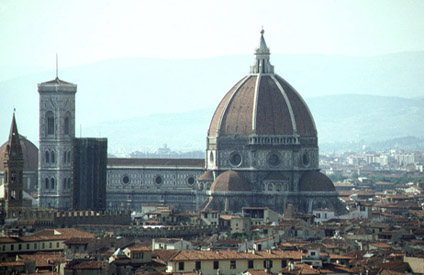
Du Fay’s first known composition is Nuper rosarum flores (1436), written for the consecration of the cathedral in Florence. This is an isorhythmic motet, which means that there is a repeating rhythmic pattern, called a talea, in at least one voice part. Du Fay was one of the most important composers of the time to write isorhythmic motets, and although he didn’t invent the genre (that honour goes to Guillaume de Machaut), he may have been one of the last to regularly employ the technique. Ian Bent has argued that “the motet presents homographic tenors and is therefore not an isorhythmic motet as often presented,” but there is some disagreement about this among musicologists.
Todd Tarantino said, “The work is divided into four sections; each begins with a florid duet between the two upper voices and continues with the entrance of the cantus firmus. Unlike a typical motet, the durations of the four sections are in a ratio of 6:4:2:3, a quite odd choice. Because of this anomaly, scholars have tried to determine the significance of these ratios. A further anomaly is found in Dufay’s choice to split the chant between two vocal/instrumental parts which are treated in a quasi-imitative manner. . . . Some have suggested that this doubling of the cantus firmus is a musical illustration of Brunelleschi’s plan to build the cupola as a dome within a dome. The cantus firmus comes from the Introit chant for a Mass for the Dedication of a Church.”
Although some recordings include instruments playing the cantus firmus, it is much more likely that the work would have been performed a cappella. A contemporary report of the first performance by Giannozzo Manetti said, “Such harmonies exalted even to heaven, that truly it was to the listener like angelic and divine melodies; the voices filled the listeners’ ears with such a wonderful sweetness that they seemed to become stupefied, almost as men were fabled to become upon hearing the singing of the sirens. I could believe without impiety that even in Heaven, yearly on this most solemn day that marks the beginning of human salvation, the angels sing thus. . . . I was so possessed by ecstasy that I seemed to enjoy the life of the Blessed here on earth.”
My classical music post for today is Guillaume Du Fay’s Nuper rosarum flores.


Leave a Reply