

Politics can shape music just as music can express political ideas. This October, the Daily Classical Music Post will look at some of the music written as a protest, commemoration, or statement of political beliefs.
William Grant Still: … And They Lynched Him on a Tree [w/ score]
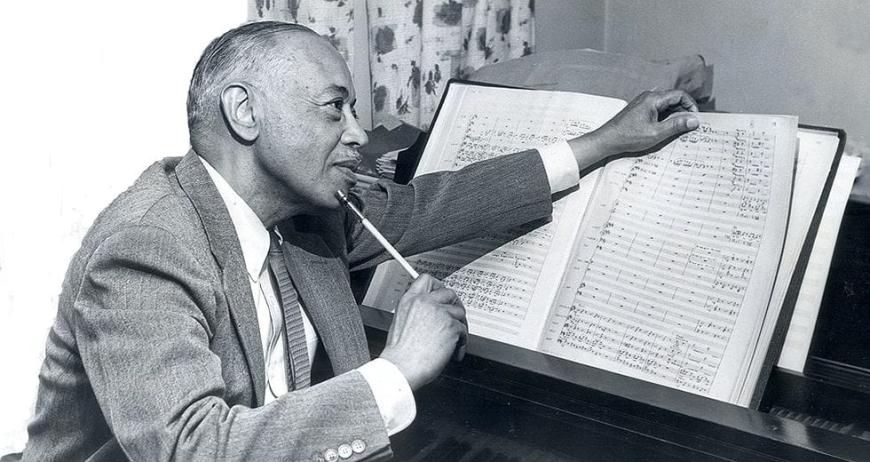
The American composer William Grant Still (1895–1978), known as the “Dean of African American composers,” was the first Black American to conduct a major American symphony orchestra (the New Orleans Philharmonic Orchestra), the first to have a symphony (his first symphony) performed by a leading orchestra (the Rochester Philharmonic Orchestra), the first to have an opera performed by a major opera company (the New York City Opera), and the first to have an opera performed on national television (on PBS).
Still’s choral work And They Lynched Him on a Tree (1940) has rarely been performed. This piece is an important example of how Still used his music to highlight social issues and injustices in early-twentieth-century America. Harlan Zachary Jr. said, “[Still] sought to use American and African American folk material in his ‘serious’ music. By the time Still was approached in 1938 to compose a work on the topic of lynching, his catalog of works had already established his reputation as a nationalistic composer focused on the plight of the African American.”
Yoshi Campbell and David Hodgkins said, “And They Lynched Him on a Tree was a collaboration between a Black composer, William Grant Still, and a white poet, Katherine Garrison Chapin. The project was encouraged by Alain Locke, a leader of the Harlem Renaissance, and Charlotte Mason, the self-named ‘Godmother’ and patron of that movement, and Chapin’s aunt. . . . The work was premiered in 1940. . . . The New York Philharmonic, under the direction of Artur Rodziński, premiered the work for a large audience. Invitees included a Supreme Court justice, a U.S. senator, a Cabinet Secretary, and First Lady and human rights activist Eleanor Roosevelt. Chapin chose the premiere date to help promote passage of an anti-lynching bill that had passed the House of Representatives and was stalled by the threat of filibuster in the Senate.”
The programme from an exhibition featuring items from the first performance noted, “The text of And They Lynched Him On A Tree . . . is considerably more graphic than earlier poems that address the act, but nevertheless it leaves the details to the audience’s imagination. Biddle’s poem is clearly about the inherent evil of lynching, rather than the possibility of hanging an innocent person, as the narrative tells us that the victim has been sentenced to life in prison for the crime of murder. The poem is also rife with biblical references (the title itself echoes ‘and they nailed him to the cross’).”
And They Lynched Him on a Tree is written for narrator, soloist, Black choir, white choir, and orchestra (specified in the score). The white choir represents the townspeople who lynched the Black man, while the Black choir represents the family and friends of the victim. The narrator’s race is not specified. The Black contralto soloist portrays the victim’s mother. The Black choir and white choir sing separately for much of the work, later merging and singing together of the hope for justice. This powerful and emotional work has as much relevance today as when it was composed and first performed.
My classical music post for today is William Grant Still’s And They Lynched Him on a Tree.


Leave a Reply