

Composers dedicate pieces of music to others for many reasons. Sometimes it is a way to thank or honour a mentor or patron. Sometimes it is to express friendship or love interest. Maybe the composer wants to remember someone close to them who has died. And maybe it’s just to celebrate a favourite place or event. This September, the Daily Classical Music Post is introducing you to a selection of works with dedications.
John Cage: Music of Changes (1951)
The American composer John Cage (1912–1992) wrote many cutting-edge works. One of the most groundbreaking was the solo piano work Music of Changes (1951). This work was dedicated to Cage’s friend David Tudor, who was a pianist. Tudor collaborated with Cage on this and many other works.
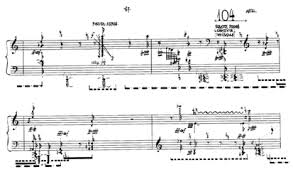
johncage.org says of the work, “The title Music of Changes is variously meaningful, the first, of course, being reference to the Chinese oracle book the I Ching, or Book of Changes, of which Cage made extensive use in composing the piece. Another, more personal, reference is perhaps seen in the changes taking place in Cage’s overall compositional language at the time. For this work, Cage employed I Ching-derived chance operations to create charts for the various parameters, i.e. tempi, dynamics, sounds and silences, durations, and superimpositions. With these charts, he was able to create a composition with a very conventional manner of notation, with staves and bars, where everything is notated in full detail. The piano is played not only by using the keys, but also by plucking the strings with fingernails, slamming the keyboard lid, playing cymbal beaters on the strings, striking the keyboard lid, etc. Use of the pedals is also notated in full detail. The notation is proportional, where 1 inch equals a quarter note. The rhythmic structure is 3, 5, 6 3/4, 6 3/4, 5, 3 1/8, and is expressed in changing tempi, including the use of accelerandi and ritards.”
Music of Changes was Cage’s first “chance composition” works. It was not an easy work for Tudor to learn to play; Cage recalled that his friend had to learn “a form of mathematics which he didn’t know before” and that this was “a very difficult process and very confusing for him.” Tudor premiered the entire work in 1952, and later recorded it.
My classical music post for today is John Cage’s Music of Changes.


Leave a Reply