

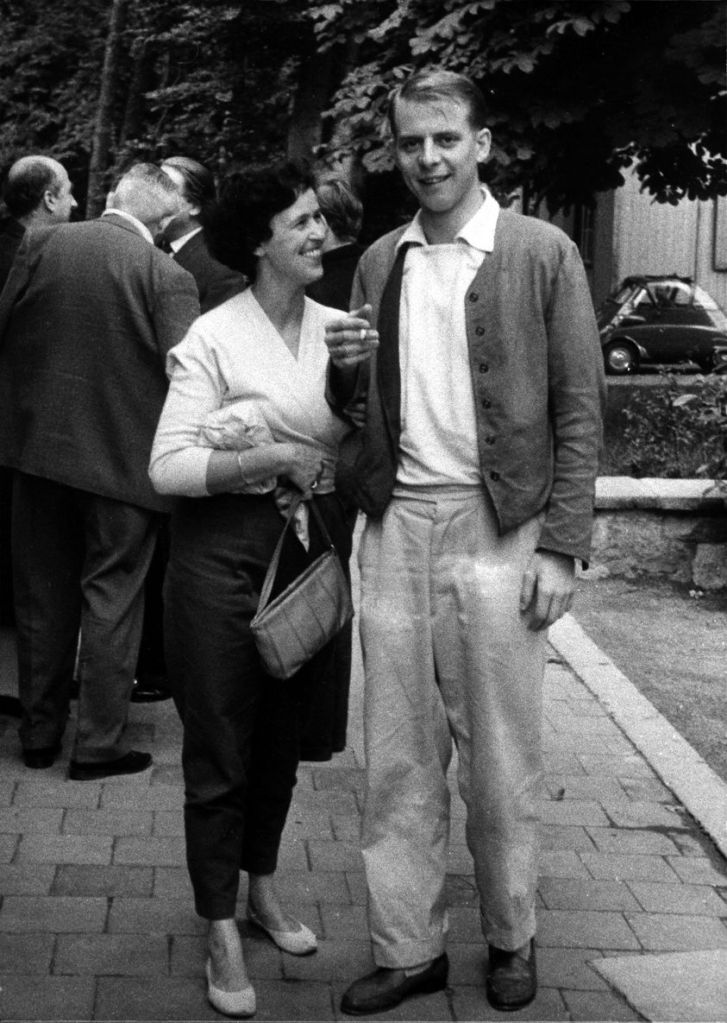
Composers dedicate pieces of music to others for many reasons. Sometimes it is a way to thank or honour a mentor or patron. Sometimes it is to express friendship or love interest. Maybe the composer wants to remember someone close to them who has died. And maybe it’s just to celebrate a favourite place or event. This September, the Daily Classical Music Post is introducing you to a selection of works with dedications.
Karlheinz Stockhausen: Chöre für Doris (1950)
The German composer Karlheinz Stockhausen (1928–2007) was one of the most important—and controversial—composers of the 20th century. His electronic music compositions examine aleatoric techniques, including controlled chance, as well as explore spaces and serialism. Although he claimed inspiration from composers including Olivier Messiaen, Edgard Varèse, and Anton Webern, his musical language is really all his own. In many of his works, he pushed the boundaries of the voices or instruments. Although there is an improvisatory element to his music, it is actually quite restricted, and some musicians have pushed against this over the years.
Chöre für Doris for a cappella choir was composed in 1950. It began life as Chöre nach Verlaine (Choruses after Verlaine), but when Stockhausen decided to dedicate the work to his first wife, Doris, he changed the name. Doris was his muse for many years, even after they divorced in the mid-1960s.
Chöre für Doris is in three movements. The first is for SATB choir with soprano solo; the second is for SSAATTBB; and the third is for SATB choir. The text is German, translated from the French poems of Paul Verlaine. There is no real connection between the text of the movements; these really are more like three separate works. The pitches throughout are organized from derivations of a 12-tone row, but rhythms are more regular than some of Stockhausen’s other works at this time. There is also more of a tonal feeling in Chöre für Doris than in his later compositions.
My classical music post for today is Karlheinz Stockhausen’s Chöre für Doris.


Leave a Reply