

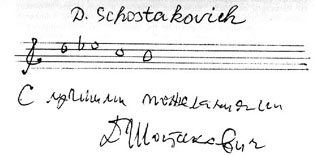
Composers dedicate pieces of music to others for many reasons. Sometimes it is a way to thank or honour a mentor or patron. Sometimes it is to express friendship or love interest. Maybe the composer wants to remember someone close to them who has died. And maybe it’s just to celebrate a favourite place or event. This September, the Daily Classical Music Post is introducing you to a selection of works with dedications.
Passacaglia on DSCH: Pars Prima: Sonata allegro
I mentioned earlier this month that one of the most famous musical cryptograms is the DSCH motif, used often by the Russian composer Dmitri Shostakovich to represent himself in his works. The motif is D-E♭-C-B (B natural is H in German musical notation). So, this spells D. Sch.
The Scottish composer Ronald Stevenson (1928–2015) composed his Passacaglia on DSCH between the end of 1960 and the middle of 1962. This large-scale work for solo piano received its premiere by the composer in December 1963. Stevenson presented a copy of the score to Shostakovich at the 1962 Edinburgh Festival.
The Passacaglia takes almost 90 minutes to perform. It is in one movement, and it is one of the longest single-movement works for the piano. The DSCH motif is in the bass part, acting basically as a ground bass for most of the piece. Raymond Clarke said, “A notable aspect of this piece is that from beginning to end a sophisticated process of continuous development progresses independently of the passacaglia form itself. As well as subtle thematic metamorphoses there are hundreds of tiny cross-references between sections which ensure that upon repeated hearings the listener registers certain passages subconsciously as anticipations of analogous passages to come, whilst regarding others in the light of corresponding sections still in his or her memory.”
Throughout the Passacaglia, there are references to historical events as well as musical influences. There is a suite of dances, a Scottish bagpipe transcription, a mainly percussive section titled To Emergent Africa, another section based on the Dies Irae chant inscribed In memoriam the six million (a reference to the Holocaust), and a nod to Baroque fugues and variations. It is a fascinating and remarkable work.
My classical music post for today is Ronald Stevenson’s Passacaglia on DSCH.


Leave a Reply