

Composers dedicate pieces of music to others for many reasons. Sometimes it is a way to thank or honour a mentor or patron. Sometimes it is to express friendship or love interest. Maybe the composer wants to remember someone close to them who has died. And maybe it’s just to celebrate a favourite place or event. This September, the Daily Classical Music Post is introducing you to a selection of works with dedications.
Ravel: Menuet sur le nom de Haydn
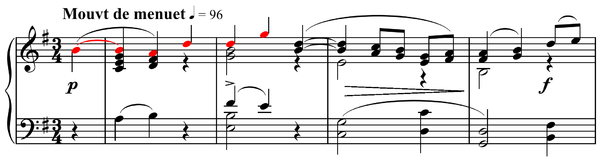
In 1909, the Revue musicale mensuelle de la Société Internationale de Musique commissioned six composers (Maurice Ravel, Claude Debussy, Vincent d’Indy, Paul Dukas, Reynaldo Hahn, and Charles-Marie Widor) to write a piece based in the musical equivalent of Joseph Haydn’s name: H = B natural, A and D = their respective pitches, Y = D natural, and N = G natural. These pieces were to commemorate the centenary of Haydn’s death. Ravel (1875–1937) chose to compose a short work for solo piano. Menuet sur le nom d’Haydn is only 54 bars long and takes just about a minute and a half to perform.
The tradition of writing a musical cryptogram—that is, a sequence of musical symbols that are translated to use a name as a theme or motif—probably dates back to Josquin des Prez in the late 15th century. Several of Josquin’s contemporaries imitated his use of Guido of Arezzo’s syllables to spell out the name of the dedicatee of their works. The most famous use of this technique is the more than 400 works on B-A-C-H (commemorating Johann Sebastian Bach). In the 20th century, a great proponent of the musical cryptogram was Dmitri Shostakovich.
Blair Johnston said, “When he sat down to compose his homage to Haydn, Ravel did not try to capture anything of the earlier composer’s style beyond the vague superficial strokes. Instead, the Menuet is an agreeable mélange of old and new, a work somewhat Classical in gesture and form but distinctly Revelian in harmony and narrative aesthetic. . . . The Minuet is a good deal more chromatic, and more reliant on typically Ravelian seventh and ninth chords, than anything Haydn would have written; at the same time, its basic dance flow is not at all contrary to the Classical style. Features such as dense, sliding parallel sonorities and characteristic, unexpected harmonic shifts bear the unmistakable stamp of Ravel’s own musical language.”
My classical music post for today is Maurice Ravel’s Menuet sur le nom d’Haydn.


Leave a Reply