

This June, the Daily Classical Music Post celebrates Pride Month by listening to music written by LGBTQIA+ composers throughout history.
Capricorn Concerto for Flute, Oboe, Trumpet and Strings, Op. 21: I. Allegro ma non troppo
Samuel Barber (1910–1981) was drafted into the U.S. Army in 1942. At first, he asked if it might be possible to use a vacant room to compose during his free time, but this was deemed a “dangerous military precedent” and his request was denied. Somehow, he came to the attention of General Barton K. Yount, whose wife was a great music lover. Chris Myers said, “Private First Class Samuel Barber found himself transferred to the Army Air Corps in Fort Worth, Texas, reporting directly to the General. Yount soon decided that Barber was most valuable to the war effort if he was composing music in the ‘best working conditions possible’. Barber spent the rest of the war ‘assigned’ to West Point, which allowed him to compose at the new home he purchased in Mount Kisco, New York, with his partner, Gian Carlo Menotti—a house they dubbed ‘Capricorn’ . . . ”
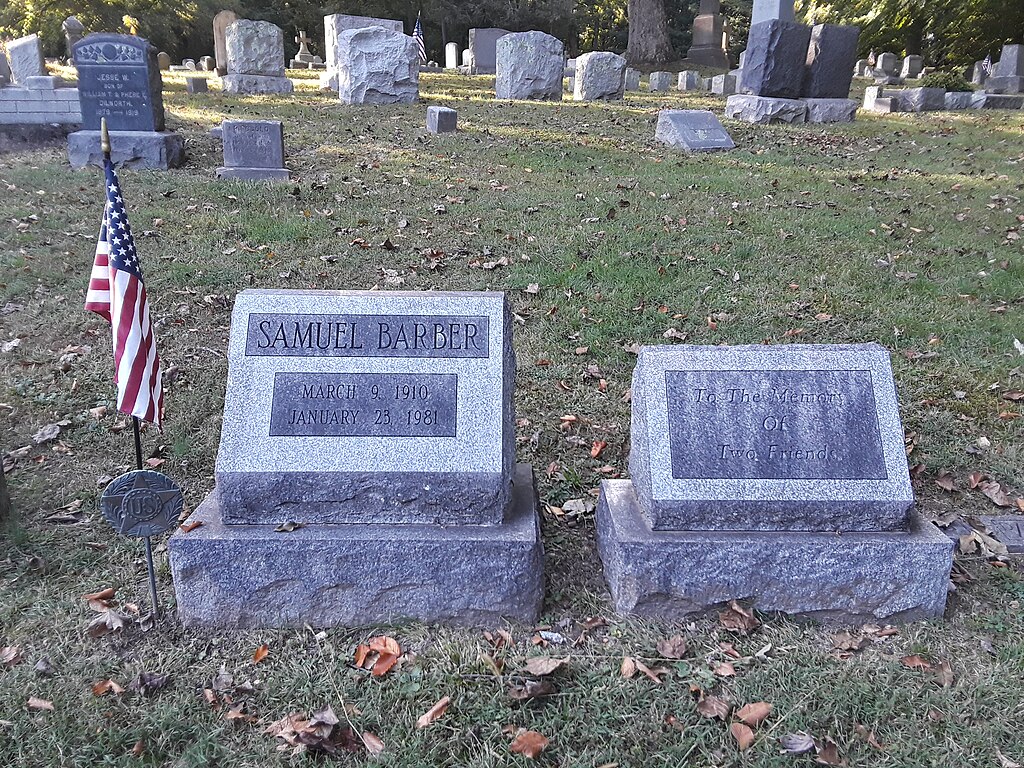
Tim Ashley said, “Menotti [has been] described as Barber’s ‘life-long partner’ or ‘life-long friend’. . . . Biographies of either man refrain from defining their relationship as homosexual, and the emotional vicissitudes between them, though frequently alluded to, remain imperfectly documented. They met as students at the Curtis Institute in Philadelphia in 1928. Barber was 18, Menotti a year younger. They remained companions, shuttling between the US and Italy until the outbreak of the second world war, finally moving, in 1943, to a mansion in upstate New York bought with money donated by one of Barber’s female sponsors. The property was sold in 1973, when Menotti decided to return to Europe. Thereafter, their relationship was seemingly conducted at long distance. Menotti settled in Scotland . . . Barber, who described himself in later life as ‘homeless’, died of cancer in New York in 1981. Menotti was at his bedside.” (Today’s image is of Barber’s grave; the plot next to his had been purchased for Menotti but he was buried in Scotland.)
Barber’s Capricorn Concerto, Op. 21, named for the house in Mount Kisco, was completed in 1944. Barber used the same instrumentation as J.S. Bach did in the Brandenberg Concerto No. 2: flute, oboe, trumpet, and strings. This three-movement concerto grosso shows some influences of Stravinsky and neo-classical style. This was the last piece that Barber composed before he was discharged from the Army.
My classical music post for today is Samuel Barber’s Capricorn Concerto, Op. 21: I. Allegro ma non troppo.


Leave a Reply