

Chamber music, sometimes described as “the music of friends,” is generally used to refer to music composed for a small group of instruments or voices, with one performer to a part. The intimacy of chamber music makes it a perfect genre for compositions marking important events or for unusual combinations of instruments. This April, the Daily Classical Music Post introduced you to some of these very special works.
Samuel Coleridge- Taylor:Nonet in F minor,Op.2(1894)
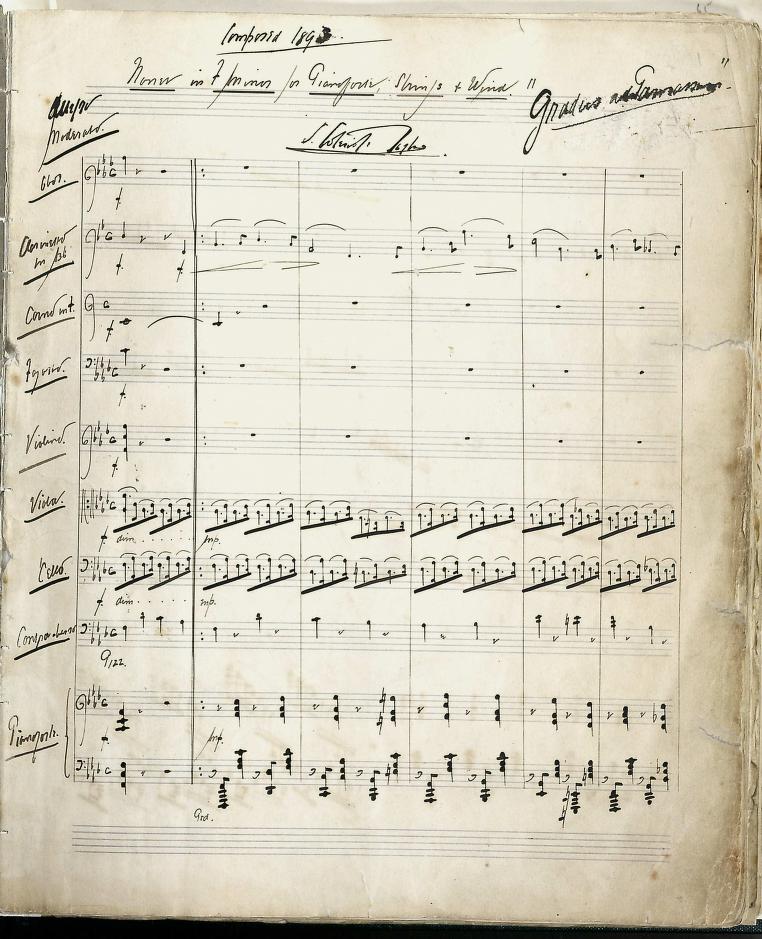
Our final selection in this month’s theme is one of my favourites. The British composer Samuel Coleridge-Taylor (1875–1912) wrote his Nonet in F minor in 1894. The instrumentation—oboe, clarinet, bassoon, horn, violin, viola, cello, contrabass, and piano—makes this beautiful work sound lush and full, even though only nine people are playing.
The first work to actually be called a nonet was Louis Spohr’s Grand Nonetto in 1813, but Josef Haydn, Ignaz Pleyel, and Franz Schubert had all composed for some combination of nine instruments. However, the particular instrumentation that Spohr used became standard for pieces actually called nonet, including those by Louise Farrenc, Georges Onslow, Franz Lachner, Josef Rheinberger, and Tilo Medek. Coleridge-Taylor took the standard instrumentation and replaced the flute with piano; it is this that makes his nonet truly unique.
Coleridge-Taylor’s Nonet was only performed once in his lifetime, in a concert at the Royal College of Music, London, in 1894. Jane Ellsworth said, “The Nonet is in four large movements, and its scoring makes it almost orchestral in sound. The influence of Dvořák, whom Coleridge-Taylor admired greatly, is evident in the opening theme of the first movement; nevertheless, there is much individuality of style throughout the entire work. The slow movement is characterized by florid lines and a truly masterful second theme. . . . The duple-meter Scherzo has been aptly described by Geoffrey Self (The Hiawatha Man, 1995) as ‘goblinesque,’ with its minor key and pervasive pizzicato in the strings, but it also contains a lyrical trio. The final movement does not adopt a conventional ‘finale’ character—neither light and playful, nor heroic—but rather, with its major key and rousing spirit, conveys a sense of easy, unexaggerated confidence.”
My classical music post for today is Samuel Coleridge-Taylor’s Nonet in F minor.


Leave a Reply