

Chamber music, sometimes described as “the music of friends,” is generally used to refer to music composed for a small group of instruments or voices, with one performer to a part. The intimacy of chamber music makes it a perfect genre for compositions marking important events or for unusual combinations of instruments. This April, the Daily Classical Music Post will introduce you to some of these very special works.
In February, we listened to Arnold Schoenberg’s work Pierrot Lunaire, which was composed for a chamber ensemble consisting of flute, clarinet, violin, cello, and piano. This ensemble is known as a Pierrot ensemble.
In the mid-1960s, a group calling themselves The Pierrot Players (later to become The Fires of London) formed with this exact instrumentation first to perform Schoenberg’s work and then to commission and perform new works composed specifically for these instruments. Since then, several other ensembles have formed. In addition, many composers have written works for Pierrot ensemble, sometimes with the addition of one or two instruments or percussion. One of the more interesting of these is Zaka, by the American composer Jennifer Higdon (born 1962).
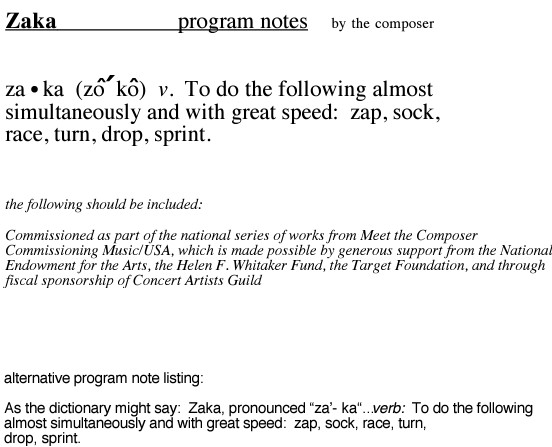
Zaka was composed for Pierrot ensemble plus percussion. Higdon said in her programme notes to the work: “As the dictionary might say: Zaka, pronounced “za’- ka“…verb: To do the following almost simultaneously and with great speed: zap, sock, race, turn, drop, sprint.” A review of a performance of Zaka in The Sacramento Bee said, “an energetic and tightly focused work that uses string instruments in percussive and unorthodox ways. It’s sophisticated writing and playing of the first order.”
My classical music post for today is Jennifer Higdon’s Zaka.


Leave a Reply