

The entertainment industry loves biopics. It doesn’t really matter if the details are exaggerated or just plain untrue: all that matters is telling a good story! Biopics about classical music composers and musicians can range from the mostly factual to out-and-out fanciful. This March, the Daily Classical Music Post will look at some of these films.
Idaspe: Ombra fedela anch’io (Air de Dario)
The history of eunuch singers in the Western classical music tradition can be traced back to the Byzantine Empire. There is a gap of about 300 years, from around 1200 CE, when nothing was said or written about them, but in the mid-16th century, castrati appeared in Italy, possibly as a continuation of the practice in medieval Spain. There are letters and records talking about castrati in Rome, Mantua, Ferrara, and other cities in Italy. Castrati took the place of boys in many church choirs, following the papal edict that women should remain silent in church.
In the late 17th century, composers began to write roles specifically for castrati, and by the mid-18th century these singers, who most often were known by one name, were basically superstars. The most famous, Sensino, Pacchierotti, Ferri, and Farinelli, drew enormous, often hysterical, crowds.
Of these four, Farinelli (born Carlo Broschi, 1705–1782) was perhaps the most celebrated, and he is considered to have been one of the greatest opera singers who ever lived. Farinelli’s family were all musicians, and his older brother, Riccardo, was a well-known composer. Farinelli also played the harpsichord and viola d’amore, and he even composed a few songs and a cantata.
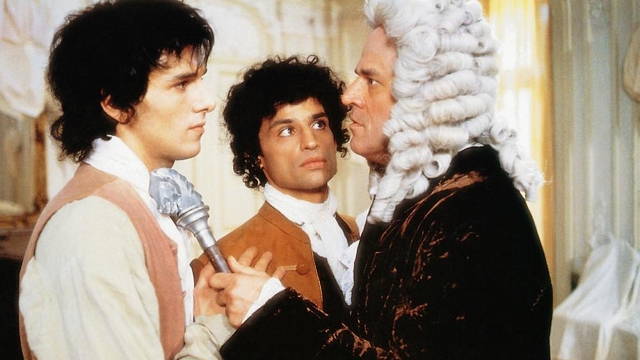
The 1994 biopic Farinelli centres on the life of the superstar singer and his relationship with Riccardo. Stefano Dionisi portrays Farinelli and Enrico Lo Verso is Riccardo. Much of the film is told in flashback. Jeroen Krabbé is George Frideric Handel, who is dismissive of Riccardo’s music and also pretty mean to Farinelli when they first meet, although much later he faints from joy when he hears Farinelli sing. There is no historical evidence for this. Handel reveals to Farinelli that it was his brother Riccardo who took the decision to have him castrated. This also is unlikely to be what happened.
There is (of course) a love triangle with a fictional character, Alexandra. Guy Vollen said, “The partnership extends offstage: ‘Beware the Broschi brothers,’ the widow Margareth later tells her servant Alexandra: ‘It is said that they share everything, even their conquests.’ This is also shown to be true, a ‘pact’ between the brothers that all the women drawn to Carlo by his charisma and success will first be pleasured by him (capable of performing, but not of climaxing) and then by Riccardo. This particular arc reaches a conclusion that is dramatically logical, but may strike modern viewers as overly tidy or simply gross.” I won’t spoil what this conclusion is, but, before you ask, no, it never happened.
The music in Farinelli is a bit of a treat, with works by N. Porpora, J.A. Hasse, G.B. Pergolesi, Handel, and, of course, Riccardo. I have to admit that I never heard of Riccardo Broschi before seeing this film, and although his music is pleasant enough, I can understand why. Farinelli’s singing voice is dubbed by the Polish soprano Ewa Malas-Godlewska and the American countertenor Derek Lee Ragin; they were recorded separately and then mixed to attempt to recreate the sound of a castrato. As I never heard a castrato, I don’t know how historical this is, either. But I guess it could be what Farinelli sounded like.
My classical music post for today is Riccardo Broschi’s Idaspe: “Ombra fedela anch’io.”


Leave a Reply