

The entertainment industry loves biopics. It doesn’t really matter if the details are exaggerated or just plain untrue: all that matters is telling a good story! Biopics about classical music composers and musicians can range from the mostly factual to out-and-out fanciful. This March, the Daily Classical Music Post will look at some of these films.
J. Strauss II: Tales from the Vienna Woods Waltz, Op. 325
I am pretty sure that the first name that comes to most people when someone says “waltz” is Strauss. The Austrian father and son composers Johann Strauss I (1804–1849) and Johann Strauss II (“Schani,” 1825–1899) had the waltz market pretty much cornered in the 19th century. The father wanted the son to be a banker rather than a musician, but after the father left the family for his mistress, the son concentrated on a career in music, and far surpassed his father in output and popularity.
The relationship between I and II has been explored in several films. Alfred Hitchcock made a biopic called Waltzes from Vienna (also known as Strauss’ Great Waltz; 1934). Four years later, The Great Waltz was released. This film, directed by Julien Duvivier (with uncredited direction by Victor Fleming and Josef von Sternberg) concentrated on II only. The Great Waltz was kind of remade in 1972 but bears little resemblance to the 1938 biopic.
Waltzes from Vienna starred Esmond Knight as Schani and Edmund Gwenn as the elder Strauss. Hitchcock based his film on the stage musical/operetta of the same name, although he didn’t use any of the music from the stage show. The film purports to tell the story of the writing of the waltz “An der schönen blauen Donau,” Strauss II’s most popular work, which most of you will know as “The Blue Danube.” The plot centres on a love story, with a totally invented baker’s daughter, Resi, as II’s love interest who wants II to marry her and take over her father’s bakery (I really am not sure where the “baker” thing came from; I guess “banker” and “baker” are kind of close to each other).
Anyway, one thing leads to another, and Resi realises that II has musical talent, so seems to support his desire to be a professional musician, but then a Countess gets involved, and there is a love triangle, and I is still against II’s career choice, and things get out of hand. But in the end, “The Blue Danube” becomes a crowd favourite, and Resi and II reconcile, and I am just very confused.
Hitchcock maintained that this film was the low point of his entire career. It’s the only musical in his oeuvre. Given the fact that so much was made up and fictional, he could have added a horror element and no one would have noticed, and he might have been happier with the final result.
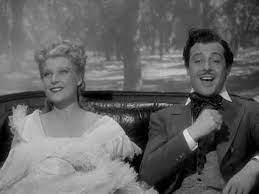
The Great Waltz has a different cast of characters, although there is a baker’s daughter, but Strauss I doesn’t feature at all. Fernand Gravet portrays Schani. My favourite moment is when Schani is running from the authorities after having been involved in a student protest; he ends up in the Vienna Woods, and as he rides along in a carriage with the (once again wholly invented) love interest in this film, various noises join up to form a complete “Tales from the Vienna Woods.” Yeah, that’s exactly how that happened. You’ve got to see it to believe it: “Tales from Vienna Woods” (“The Great Waltz”).
My classical music post for today is Johann Strauss II’s “Tales from the Vienna Woods.”


Leave a Reply