

Witold Lutosławski: Variations on a Theme by Paganini
Oscar Wilde famously said, “Imitation is the sincerest form of flattery that mediocrity can pay to greatness.” It isn’t always the case, at least in classical music, that the imitator is mediocre; many compositions that are based on another composer’s work are just as interesting—and sometimes even more interesting—than the original. This October, the Daily Classical Music Post will look at variations, fantasias, and other compositions that are based on another composer’s work.
Lutoslawski: Variations on a Theme by Paganini for Two Pianos
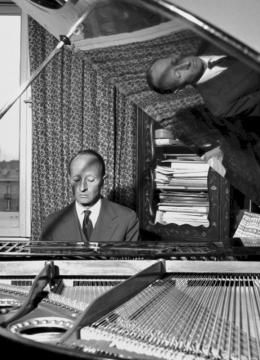
The Polish composer Witold Lutosławski (1913–1994) and his friend and fellow pianist Andrzej Panufni formed a duo to perform in small clubs in Warsaw in the early years of World War II (as the Nazis had banned public concerts). Lutosławski made hundreds of arrangements of well-known classical music for two pianos. However, the chaos surrounding the Warsaw Uprising in 1944 led them to flee the city, taking only the bare essentials with them. Of Lutosławski’s 200-some-odd arrangements, only one survived: the Variations on a Theme by Paganini.
Lutosławski took Niccolò Paganini’s Caprice No. 24 from the set of 24 Caprices for violin and created variations on Paganini’s variations. Following the initial statement of the theme, there are 12 variations and a final coda. Although Paganini’s classical structure is retained, Lutosławski incorporated many of the techniques popular in classical music in the mid-20th century: polytonality, parallel fifths (a definite no-no in Paganini’s day), and tritones (also frowned upon as its dissonance was associated with the devil). The variation just before the coda is the only completely newly composed section of the Variations. Lutosławski arranged the Variations for piano and orchestra in 1977–1978.
Lutosławski was not the only composer to write variations based on this particular work; Franz Liszt, Johannes Brahms, and Sergei Rachmaninov all had their own go. Wenli Zhou said, “Liszt transcribed Paganini’s 24th Caprice for the piano, adding a multi-layered sound to the original Caprice. His treatment of the Paganini theme is the most literal. Lutoslawski’s Paganini Variations . . . builds on Liszt’s transcription technique: it stays close to the original Paganini Caprice, but at the same time overlays many 20th century compositional devices such as atonality and complex rhythmic devices. In his Variations on a Theme of Paganini, op. 35, Brahms keeps the clear structure and strong harmonic progression of the original theme, but carries his invention further away from the source than Liszt and Lutoslawski. . . .Rachmaninoff’s Rhapsody on a Theme of Paganini, Op. 43 . . . places greater emphasis on the melodic and motivic elements of the theme, and nearly exhausts every option of transformation.” Stephen Hough said, “Paganini’s Caprice No 24 has been used by so many composers as a theme to be varied for a number of reasons. It is written in the clean, white-note key of A minor . . . a textbook example of classical harmony, it shifts rhythmically from tonic to dominant and back. . . . In the second half of the theme, we hear a circle of fifths. . . . As well as giving the music a strangely poignant effect, it allows it to shift instantly and infallibly to a more expressive vein. Finally, Paganini’s theme cuts a dashing rhythmic shape as its melody repeatedly turns on itself with a swagger and clip of the heel. [All of this] make this musical material eminently suitable for variation.”
My classical music post for today is Witold Lutosławski’s Variations on a Theme by Paganini.


Leave a Reply