

Serge Koussevitsky: Double Bass Concerto
September is a month of unusual holidays, including “No Rhyme, No Reason Day,” “Wonderful Weirdos Day,” “Ceiling Fan Day,” and “Punctuation Day” (a personal favourite). To celebrate unusual holidays, this September the Daily Classical Music Post will explore music composed for unusual instruments either in ensembles or featured in a soloist capacity.
Serge Koussevitzky – Double Bass Concerto | MARC-ANDRÉ, Junge Philharmonie Zentralschweiz
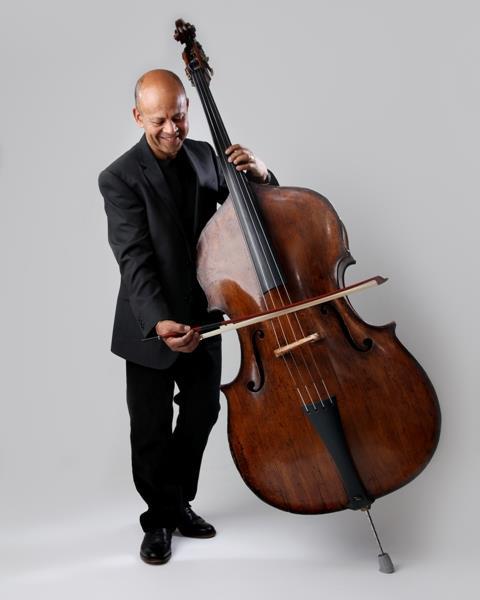
The double bass is the lowest-pitched instrument in the modern symphony orchestra. It is a member of the string section, with the violin, viola, and cello. It is an incredibly versatile instrument, appearing in classical, jazz, rock, country, bluegrass, and folk music, and so much more. In classical music, the double bass is most often played with a bow. The German bow style is underhand and the French bow style is overhand (much like bowing a cello), and the bows actually look very different.
No one is entirely sure if the double bass developed from the viol family or the violin family. It doesn’t really look like other members of the violin family, and it is tuned in fourths rather than fifths. Some scholars think that it might have begun life as a viola da gamba. In any event, it is much more common to see and hear the double bass at the back and bottom of the orchestra, not as a soloist in front of the orchestra.
The Russian conductor, composer and double bass player Serge Koussevitsky (1874–1951) wrote his Double Bass Concerto Op. 3 in 1902. He was considered a great virtuoso on the double bass. One of Koussevitsky’s assistants, Nicolas Slonimsky, claimed that most of the concerto was in fact composed by Reinhold Glière, but this has never been proved. Andrew Kohn said, “The Concerto is orchestrated for woodwinds in pairs, four horns, harp, and strings. Surprisingly, there is no percussion. Balance between soloist and orchestra, always challenging with a bass concerto, is particularly difficult in this piece.” Koussevitsky himself premiered the concerto in 1905 in Moscow.
My classical music post for today is Serge Koussevitsky’s Double Bass Concerto.


Leave a Reply