

Vaughan Williams: Job: A Masque for Dancing
First posted 12 October 2015
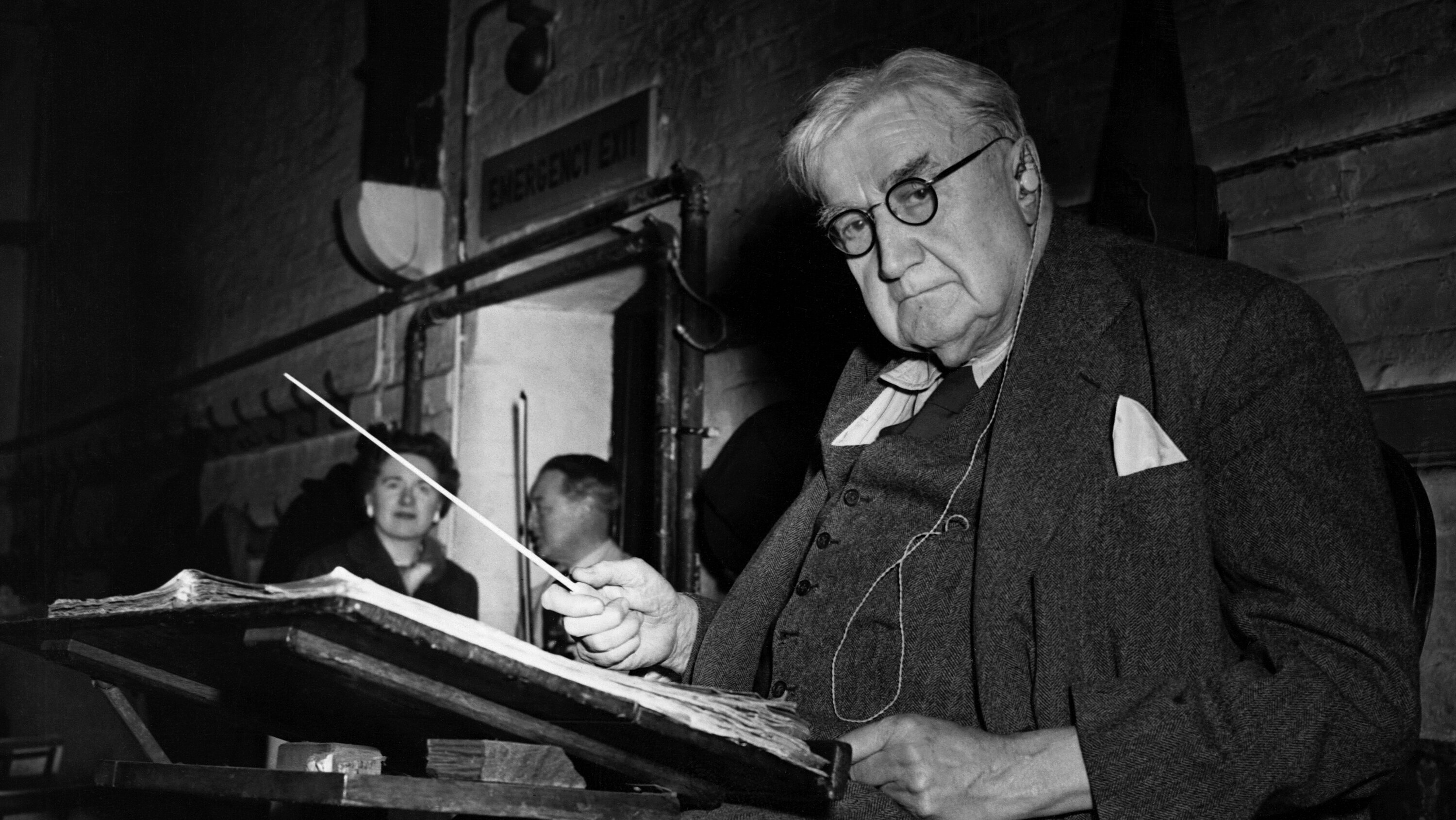
Today is the anniversary of the birth of the great English composer Ralph Vaughan Williams (12 October 1872–26 August 1958).
Vaughan Williams – Job – BBC SO / Boult
Regular readers of my Daily Classical Music Post will know that Vaughan Williams is one of my favourite composers of all time. The way that he incorporated English folk music into his extraordinary, lush writing overwhelms me every time I hear any of his works. He also resurrected the best of English 16th- and 17th-century music and used that in his compositions. The Elizabethan era had been the time of the greatest flowering of musical expression in England; for me, the early to mid-20th century was the second flowering, mainly because of Vaughan Williams.
It was so hard for me to pick something for today, as I love pretty much everything Vaughan Williams composed. In the end, I managed to find a full recording of one of his more extraordinary works.
In 1931, an all-British creative team got together and produced an incredible one-act ballet, Job. The concept for the ballet was inspired by the illustrations to the biblical Book of Job by the English poet and painter William Blake. Vaughan Williams dedicated the music to the English conductor Adrian Boult (who is conducting the version that I have shared here today). Vaughan Williams actually titled the ballet Job: A Masque for Dancing, although it is not a masque at all – he just didn’t like the word “ballet.”
The ballet is made up of nine scenes, each including a quotation from the Book of Job. Each section has a heading provided by Vaughan Williams. The scenes are:
Scene I: “Saraband of the Sons of God” (”Hast thou considered my servant Job?”)
– Introduction
– Pastoral Dance
– Satan’s Appeal to God
– Saraband of the Sons of God
Scene II: “Satan’s Dance of Triumph” (”So Satan went forth from the presence of the Lord.”)
– Satan’s Dance
Scene III: “Minuet of the Sons of Job and Their Wives” (”There came a great wind and smote the four corners of the house and it fell upon the young men and they are dead.”)
– Minuet of the Sons and Daughters of Job
Scene IV: “Job’s Dream” (”In thoughts from the visions of the night....fear came upon me and trembling.”)
– Job’s Dream
– Dance of Plague, Pestilence, Famine and Battle
Scene V: “Dance of the Three Messengers” (”There came a messenger.”)
– Dance of the Messengers
Scene VI: “Dance of Job’s Comforters” (”Behold happy is the man whom God correcteth.”)
– Dance of Job’s Comforters
– Job’s Curse
– A Vision of Satan
Scene VII: “Elihu’s Dance of Youth and Beauty” (”Ye are old and I am very young.”)
– Elihu’s Dance of Youth and Beauty
– Pavane of the Heavenly Host
Scene VIII: “Pavane of the Sons of the Morning” (”All the Sons of God shouted for joy.”)
– Galliard of the Sons of the Morning
– Altar Dance and Heavenly Pavane
Scene IX: “Epilogue” (”So the Lord blessed the latter end of Job more than his beginning.”)
As Hugh Cobbe said in the program notes accompanying the performance of Job at the Proms in 2014: “The idea of a ballet on the Blake Job illustrations was conceived by Geoffrey Keynes, whose mother was a Darwin and a cousin of Vaughan Williams, assisted by another Darwin cousin, Gwen Raverat whom Keynes asked to design the scenery and costumes. They decided to keep it in the family and approached Vaughan Williams about writing the music. The idea took such a hold on the composer that he found himself writing to Mrs Raverat in August 1927 ‘I am anxiously awaiting your scenario – otherwise the music will push on by itself which may cause trouble later on’. Out of all this emerged a musical work that exhibits the composer at the height of his powers. Often ballet music can seem only half the story when it is played apart from the dancing it was written for, but in this case the composer fully realised that an actual danced production was by no means assured (Diaghilev had firmly turned down Keynes’s offer of the ballet for Ballets Russes) and wrote a powerful piece for full orchestra, including organ, which could stand independently in a concert. . . It is no accident that two of the pieces, the Pavane and Galliard, together with the calm Epilogue, were played at Vaughan Williams’s funeral at Westminster Abbey on 19 September 1958.”
My classical music post for today is Vaughan Williams’s Job: A Masque for Dancing.


Leave a Reply