

Hector Berlioz: Harold en Italie, I. “Harold aux montagnes”
First posted 22 January 2014
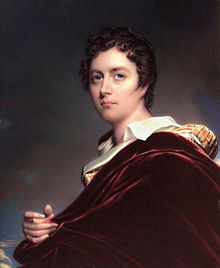
Today is the anniversary of the birth of the British Romantic poet Lord Byron (22 January 1788–19 April 1824).
Harold in Italy, Op. 16, H 68: I. Harold in the Mountains
Byron is considered to be one of the greatest British poets who ever lived. In his lifetime, he was known as much for his personal beauty and for his excesses—debts, love affairs, and the like—as for his poems including “She Walks in Beauty,” “When We Two Parted,” “So, we’ll go no more a roving,” “Childe Harold’s Pilgrimage,” and “Don Juan.” Lady Caroline Lamb described him as “mad, bad and dangerous to know.” The Greeks consider him to be a national hero because he fought with them in the Greek War of Independence against the Ottoman Empire. In 1824, while planning an attack on a Turkish fortress, Byron developed a violent fever (probably as a result of poor medical treatment for a cold) and died suddenly.
The Byronic hero, a person with an idealized but flawed character, is a major figure in many of his works, and it is probable that this hero is autobiographical in many respects. Many of Byron’s works have been the inspiration for music and literary works.
One of my favourite of these is Hector Berlioz’s Harold en Italie, a symphony in four movements for viola and orchestra composed in 1834. This work is based on “Childe Harold’s Pilgrimage.” The great violinist and violist Niccolò Paganini asked Berlioz to write a work for solo viola. When Harold en Italie was completed, Paganini was disappointed, as the viola did not play continuously. I think it makes for a much better work with the orchestra and viola almost in conversation throughout. Every instrument gets a chance to shine. Berlioz told a friend of his, “I have composed a great deal for these coming concerts; among other things there is a new symphony entitled Harold, upon which the musicians and critics are going to exercise themselves.” But he did intend the viola to be seen as separate from the orchestra, as indicated by his direction at the start of the score: the violist “should stand in the foreground, near the public and isolated from the orchestra.”
Jonathan Girard said, “ . . . occasionally a musical work comes along that is truly unique—one of a kind—and manages to remain enigmatic even after nearly two hundred years. Hector Berlioz’s Harold en Italie is one such work: a piece that holds a unique place in the symphonic repertoire because it fits into no known genre and because its meanings remain enigmatic. . . . Is Harold a symphony, a concerto, or something completely different?” It may be difficult to classify Harold en Italie, but it is not difficult to enjoy it and get swept away by the grandeur of Berlioz’s wonderful orchestration.
My classical music post for today is the first movement, “Harold aux montagnes,” of Berlioz’s Harold en Italie.


Leave a Reply