

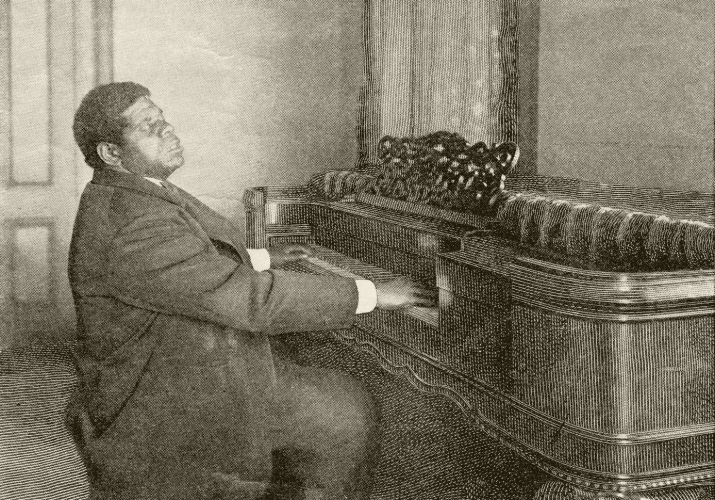
Thomas Wiggins: “The Battle of Manassas”
“I can’t change the direction of the wind, but I can adjust my sails to always reach my destination.”—Jimmy Dean
Disabled people have always been seen as less than, as not able to work in particular fields, and as in one way or another diminished. This July, the Daily Classical Music Post will introduce you to the music of composers who have broken barriers and proved that disability doesn’t mean inability.
A note: although some musicologists and armchair psychologists are retroactively deeming certain composers from the Classical and Romantic periods as ADHD, autistic, or otherwise neurodivergent, I am not going to assume that is the case.
Thomas “Blind Tom” Wiggins – Battle of Manassas (1861)
Thomas Wiggins (1849–1908) was blind from birth. He and his enslaved parents were sold to General James Bethune, who recognised the talent that the young boy had (of course, once Tom began earning, all of the money went to his owners rather than to him or his parents). In his lifetime, because he performed for white audiences, he was to some extent ostracised by the Black community. He apparently was quite an eccentric performer, and he had an extraordinary memory.
He composed several works, the most famous of which is “The Battle of Manassas,” which tells the story of that Civil War battle. Ryan Daar says, “With sharply juxtaposed fragments of Northern and Southern tunes, along with drum motifs, bugle calls, ‘The Star-Spangled Banner,’ and vocal enactments of trains and whistles—all continually interrupted by sudden ‘cannon fire’ in the left hand—Tom would finish the piece shouting ‘Retreat! Retreat! Retreat!’ at the top of his lungs before leaving two irreverent slams of the keys to reverberate throughout the hall.”
My classical music post for today is Thomas Wiggins’s “The Battle of Manassas.”


Leave a Reply