

Marianna Martines: “Il Primo Amore”
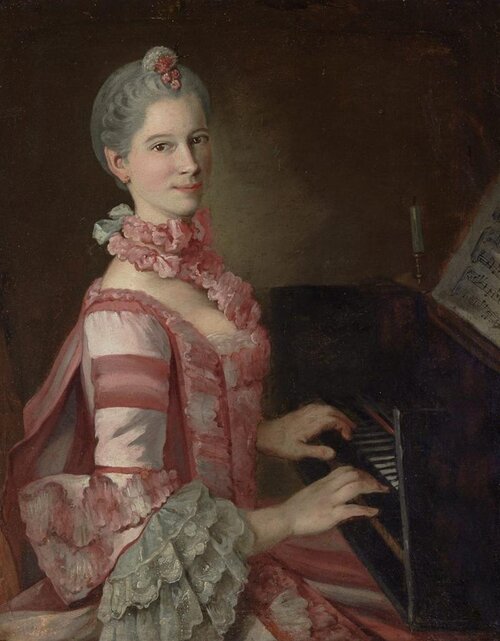
“That no woman has ever been a great composer is an accepted fact; that she is never likely to become so, more than a probability.”—Anonymous, The Musical Times (1887)
This May, the Daily Classical Music Post will set the record straight. There have been many great women composers, and I’m going to introduce you to just 31 of them and their wonderful music.
The Austrian composer Marianna Martines (1744–1812) was encouraged by her family in her musical pursuits, which was very unusual at that time. Her father, Maestro di Camera at the papal embassy in Vienna, was friends with the poet and librettist Pietro Metastasio, who realized Marianna’s talent and was able to help her in pretty extraordinary ways.
The Martines family lived in Metastasio’s building with some people connected with the Esterházy family, some of whom you may be familiar to you. For example, Nicola Porpora, the Italian singing teacher and composer, lived on the middle floors. In the cold and leaky attic, a struggling young composer named Joseph Haydn was just beginning his career. Metastasio arranged for Marianna to take lessons with Porpora (Haydn was the accompanist in these lessons), all before she was 10 years old. Marianna also had a proper general education, which was relatively unheard-of for girls in the 18th century, and she could speak several languages. Marianna showed a talent for composition, so Metastasio next arranged for her to have lessons with Johann Adolph Hasse and Giuseppe Bonno.
Marianna’s output was varied: secular cantatas, oratorios, masses, motets, and instrumental music. Of course, for the secular works, the texts were by Metastasio. Sadly, most of her compositions are missing, even though they were in print during her lifetime. Let’s hope that someone will find them some day.
“Il Primo Amore,” a cantata that Martines composed in 1778, is made up of two arias each preceded by a recitative. Martines’ gift for phrasing and melody shine throughout this work. Helene Wessely says that this cantata, as well as other works for solo voice, show “a predilection for coloratura passages, leaps over wide intervals and trills indicat[ing] that she herself must have been an excellent singer.”
My classical music post for today is Marianna Martines’ “Il Primo Amore.”


Leave a Reply