

Lorenzo da Firenze: “Non so qual io mi voglia”
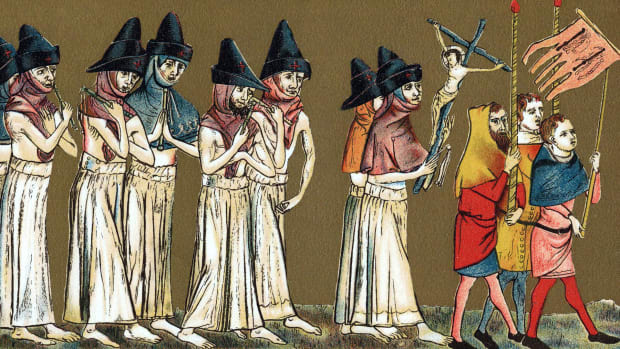
This April, the Daily Classical Music Post will look at composers who died during pandemics, as well as some who survived and a few who composed works to commemorate those who lost their lives.
“The violence of this disease was such that the sick communicated it to the healthy who came near them.”—Giovanni Boccaccio
The Italian Ars nova composer Lorenzo da Firenze (also known as Magister Laurentius de Florentia, d. 1372 or 1373) was another lucky survivor of the Black Death.
Da Firenze composed in a somewhat progressive style, and employed chromaticism much more than other composers of his time. Although very little is known about his life, a great deal of his music can be seen in the Squarcialupi Codex, a treasure-trove of 14th-century Italian music. He is particularly known for his settings of texts from Giovanni Boccaccio’s Decameron, the stories of the young men and women who “sheltered in place” in the countryside near Florence during the Black Death.
Da Firenze’s ballata (ballad) “Non so qual io mi voglia” is one of the songs performed by Boccaccio’s characters at the end of the day. Ballatas were very popular during the Ars nova period in Italy. It is assumed that the other Boccaccio ballatas were set to music as well, but the only settings that survive are those by da Firenze.
I don’t know which I want,
To live or die, to diminish [the] suffering
I would die, life weighs on me1
Seeing myself abandoned by you;
But I would not die, [because if I] passed away
I would not see [your] beautiful, loving face
[So] I weep with envy for [he] who
Had it and strips me of it!
Ballatas begin and end with the same words and music. Early ballatas, like “Non so qual io mi voglia,” are monophonic—that is, composed for a single accompanied or unaccompanied voice. There are two sections with alternating verses and refrains. The structure is described as AbbaA; the first and last “A” is the ripresa, the “b” lines are piedi, and the “a” line is a volta. There are similarities to the medieval French virelai, and there is some speculation that da Firenze had a connection with France as some of his notation appears more French than Italian. Da Firenze also might have been the teacher of Francesco Landini, the most famous Italian composer of the 14th century and an acknowledged master of the ballata form.
My classical music post for today is Lorenzo da Firenze’s “Non so qual io mi voglia.”


Leave a Reply