

Modest Mussorgsky: Pictures at an Exhibition
“The sad thing is that I leave with so much more to say.”—Béla Bartók
During February, the shortest month of the year, the Daily Classical Music Post will introduce you to (or perhaps reacquaint you with) some composers whose lives were short.
Mussorgsky – Pictures at an Exhibition (original piano version)
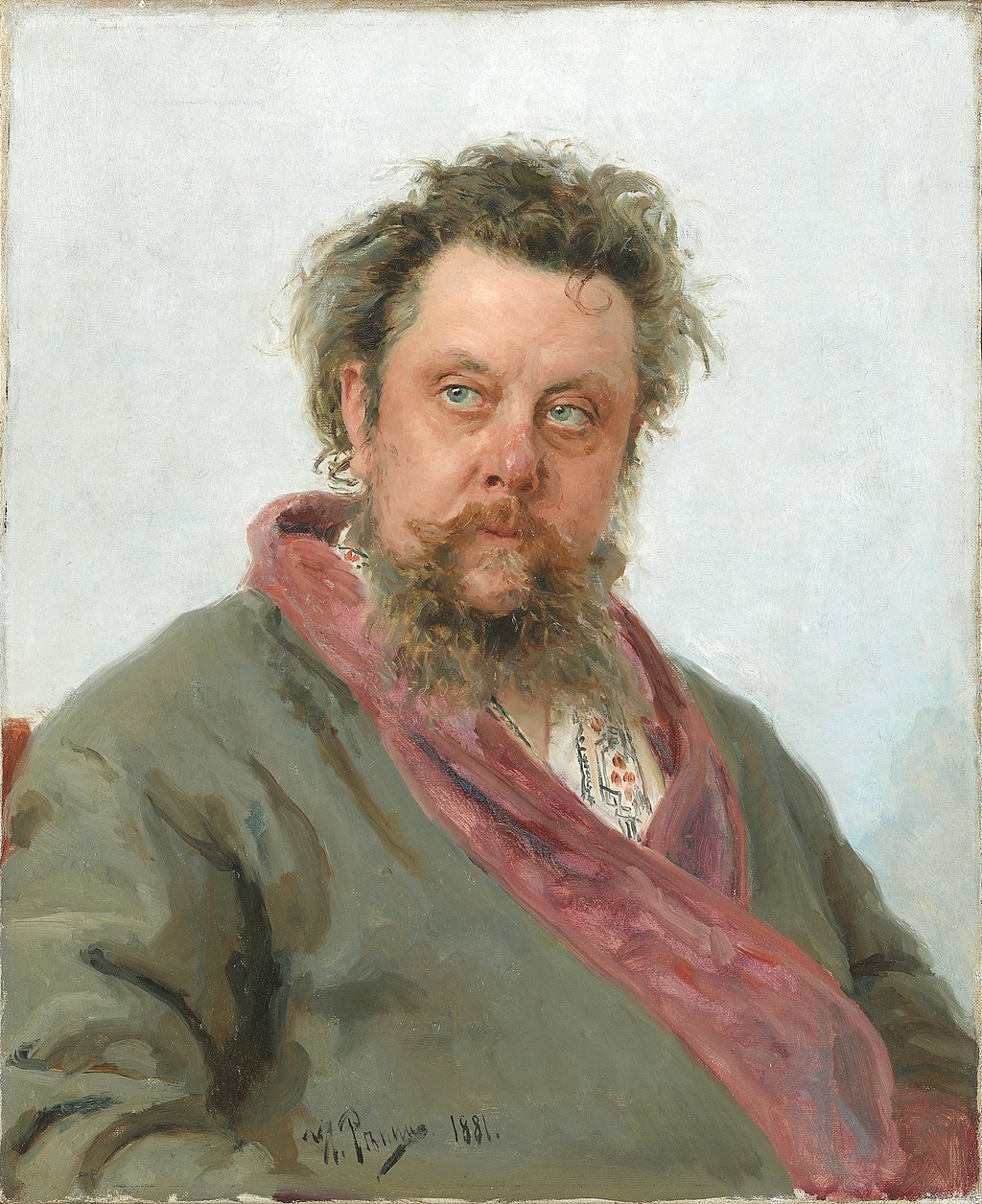
The Russian composer Modest Mussorgsky (1839–1881) was an alcoholic; that was either the cause or the result of his mental deterioration. Although he managed for most of his 42 years to produce wonderful music, he basically spent the last five to seven years in a haze, bitter, broken, and broke. Today’s image is a painting by Ilya Repin, finished just days before Mussorgsky died, and you can easily see the effect that years of drinking had on him.
Mussorgky originally composed Pictures at an Exhibition for piano in 1874, and it is still often performed that way. Many other musicians arranged and orchestrated the work, including Nikolai Rimsky-Korsakov and Luigi Dallapiccola; Maurice Ravel’s version is perhaps the most well known and most often performed.
Pictures was inspired by a show organized as a memorial to Mussorgsky’s friend Viktor Hartmann, a Russian nationalist artist who died suddenly at the age of 39. The working title for the piece was, in fact, “Hartmann.” The final title, in Russian, was Картинки с выставки— Воспоминание о Викторе Гартмане, which translates to “Pictures from an Exhibition—A Remembrance of Viktor Hartmann.” Many of the works in the show were from Mussorgsky’s personal collection, and the music that he composed was intensely personal.
The main theme of the 10-movement work is the Promenade theme. The Russian critic Vladimir Stasov wrote programme notes, and for the first movement he said, “Mussorgsky depicts himself roving through the exhibition, now leisurely, now briskly in order to come close to a picture that had attracted his attention, and at times sadly, thinking of his departed friend.“ This theme comes back in several of the other movements, and appears both as the original and also in an altered form in the final movement, “The Bogatyr Gates (in the Capital in Kiev),” more commonly called “The Great Gate of Kiev.” It is thrilling, inspiring, and magisterial.
My classical music post for today is the original piano version of Modest Mussorgsky’s Pictures at an Exhibition.


Leave a Reply