

Dick Kattenburg: Quartet for Flute, Violin, Cello, and Piano
“The sad thing is that I leave with so much more to say.”—Béla Bartók
During February, the shortest month of the year, the Daily Classical Music Post will introduce you to (or perhaps reacquaint you with) some composers whose lives were short.
Dick Kattenburg – Quartet for flute, violin, cello and piano
The Dutch composer Dick Kattenburg (1919–1944) was just 24 years old when he died in Auschwitz. At the time of his death, the only work of his that was known was his Flute Sonata, written in 1937. Kattenburg composed around 30 works between 1936 and 1944, and his sister stored them in her attic, where they were discovered by her daughter in 2004.
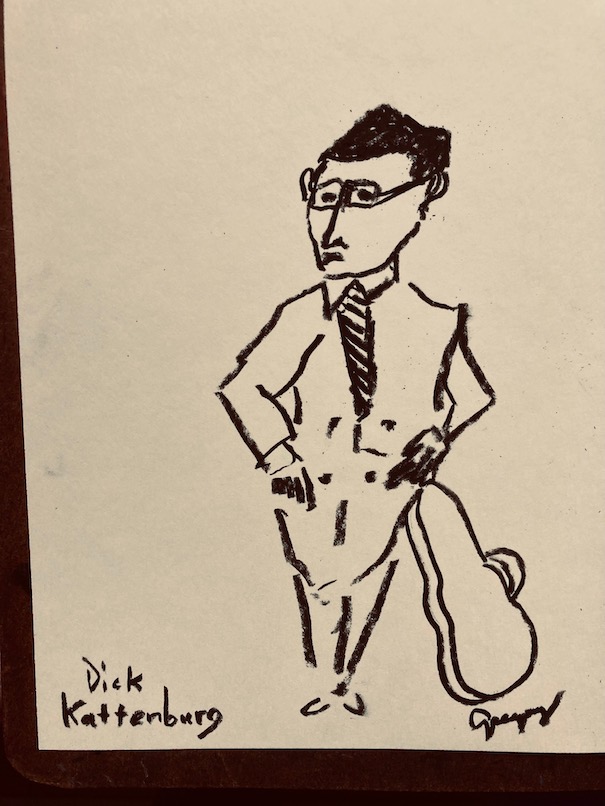
Kattenburg received a diploma in theory and violin from the Collège Musical Belge in Brussels. He loved jazz, particularly the rhythms and harmonies, and he found ways to incorporate this into his own music. In addition to his works for solo flute he also composed for piano, as well as for other solo instruments, but my favourite combination is his quartet of flute, violin, cello, and piano. Not many composers since the Baroque era had chosen this grouping, and Kattenburg seems to have a particular affinity for it. He also wrote one truly intriguing work, for piano (four hands) and tap dancer (you can hear it here: Dick Kattenburg – Tapdance (with tap dancer)! In addition, he was a bit of an artist: today’s image is his self portrait on one of his manuscripts.
In the few years before he was transported to Auschwitz, Kattenburg took composition lessons from Leo Smit (another casualty of World War II; Smit died in Sobibor at the age of 42). Kattenburg’s style, mostly Romantic with a little touch of Impressionism, began to show signs of polytonalism during this period. He also wrote some songs using Hebrew texts, but in an attempt to make sure that they survived World War II, he said that the texts were either Mexican or Palestinian.
My classical music post for today is Dick Kattenburg’s Quartet for Flute, Violin, Cello, and Piano.


Leave a Reply